

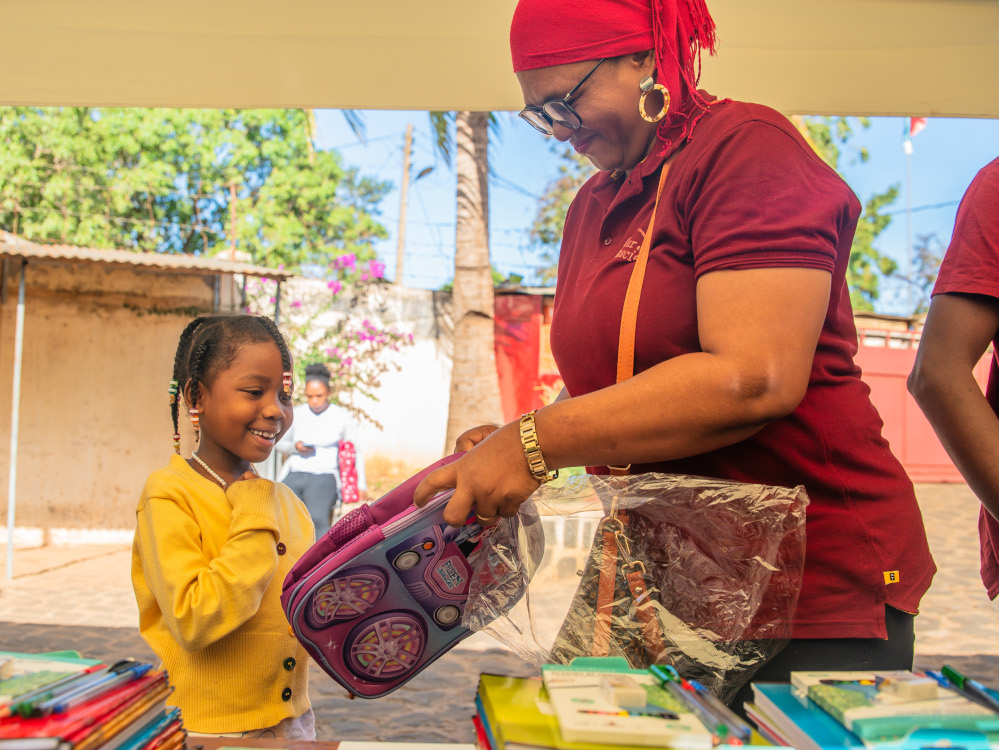
Donating money to charitable causes or organizations outside Canada isn’t difficult, but obtaining a Canadian tax receipt for those donations can be far more complicated. Canada Revenue Agency rules designed to prevent money laundering, fraud and the funding of terrorism make it difficult for foreign organizations, no matter how deserving, to offer Canadian tax benefits to Canadian donors.
Giving to international causes has taken on extra urgency following last year’s announcement by the U.S. government that it was shutting down its 64-year-old humanitarian aid and development agency known as USAID. The move sent destabilizing shock waves around the world. The program provided money for food in countries where people are starving and healthcare where there is little to go around, not to mention funding education and promoting economic growth.
Wealthy Canadians often use legal, financial and charitable structures to facilitate international giving while staying tax-compliant. One organization providing donors with a more tailored approach to international philanthropy is Myriad Canada. It helps design customized, hands-on giving while providing domestic tax benefits. Its executive director is Benoit Fontaine, who has deep experience in the philanthropic sector and is guided by his personal ambition to create the maximum positive impact on society.
Fontaine led major youth charities in Europe before joining the Brussels-based King Baudouin Foundation, which invests in inspiring projects and individuals. He moved to Canada from Belgium in 2017 to start Myriad Canada, and today he draws on decades of experience in venture philanthropy and impact-focused program design.
In this interview, Fontaine talks about enabling highly personalized international giving—and why that level of engagement can be especially meaningful for donors.
What does Myriad Canada do?
We’re a registered charity that enables Canadian donors to support international charitable projects worldwide.
What is the history of Myriad Canada?
Myriad goes back to the King Baudouin Foundation, which started in 1976 in Brussels. It’s a large public benefit foundation with an endowment valued at CAD$3 billion. In Brussels, we work on all charitable sectors with the exception of religious projects: poverty alleviation, health, scientific research, environment, arts and international development. The foundation has its own assets and supports its own projects, and also manages many donor advised funds.
For 50 years, we’ve worked with families to help them to realize their philanthropic goals, and there is often one recurring theme, which is the international dimension: people want to support projects in other countries.
So, 15 years ago, the board decided to set up the infrastructure needed to facilitate cross-border giving. They created foundations in Canada, the U.S., Australia, New Zealand, Singapore, Hong Kong and China. I came to Canada to start Myriad Canada in 2017, and now we help Canadians support their favourite causes abroad.
Why do people choose to work with Myriad over giving to an existing charity?
For the people who contact us, there is a trigger—an emotion, a personal story—that makes their philanthropic projects very close to their heart. I’ll give an example: A couple from Toronto travelled to Tanzania. One of them had a heart attack, and his life was saved by a local hospital in Tanzania. So when he came back, he contacted us. We set up a fund to make it possible for his friends and family to support the project, in order to provide medical equipment to the hospital. They could support an existing NGO, which is super-important as well, but it’s not going to be a customized project. You’ll just give money, and you’ll trust the organization to use it in the best way.
But the people who contact us really want to customize something.
I mean, $200 can cover a girl’s school tuition for an entire year in Kenya. What can you do with $200 in Canada?
Another example is the Rossy family [founders of what would become the Dollarama retail chain]. They moved to Canada in the 19th century, but originally they came from Lebanon, so when something is happening in Lebanon, they are touched. The family has its own foundation to support organizations in Canada. So they set up a fund at Myriad Canada to support Lebanese university students. At the moment, we support 70 students at four universities in Lebanon. We follow them one-by-one, and it’s a five-year project because they believe supporting students is important for the rebuilding and the future of Lebanon.
What is unique about Myriad’s service?
We can really customize things, so if a donor wants to support education, we’ll discuss the possibilities, from giving to a university to funding scholarships—maybe scholarships for young girls, or scholarships in a specific discipline. We have a network that can help a donor find a project in a specific region of the world that they want to support.
At the moment, we have projects in 42 countries. In some countries, it’s necessary to do much more due diligence to be sure that the money is properly used. We can offer a trusted experience and control over the project so it’s personalized. We also visit many of our projects. For significant projects over $100,000, we go on the ground to control what’s happening, which is another added value.


What is the experience like for donors?
Before we really begin anything official and start working together, we spend a lot of time listening. We hear their stories. We try to understand. For me, that’s my passion—to listen to people and understand what they really want to achieve and why. It’s a fascinating part of the job, and we get to know our donors very well.
How do Canadian tax receipts work for international donations?
To get a tax receipt, you need to give money to a qualified organization, which is to say an organization that has a CRA recognition number. So, let’s say you want to give $100,000 to a school in Kenya, but the school is not known by the CRA. So you give the money, but you don’t get the tax receipt.
If you give it to us, we do the due diligence and organize and track the donation to ensure the donation is used for an impactful charitable project. And we have a CRA number, so we will give you a tax receipt. That’s the difference. Because we have the network, the capacity and the processes in place, we have large charitable purposes approved by the Canada Revenue Agency to support and to carry out projects abroad on poverty alleviation, scientific research, education, environment, health and art.
We are also very complementary in the Canadian philanthropic space—that is super-important in our DNA. So, for example, the lead of philanthropy at the Toronto Foundation, Aneil Gokhale, sits on our board. If one of their donors wanted to fund work outside Canada—something outside their mission—they come to us. And if a Toronto-based donor came to us to support a project in Toronto, I would refer them to a partner like the Toronto Foundation.
How much does Myriad give?
Last year, accounting for all Myriad members across all offices, we granted more than US$300 million.
Are there other organizations who do what you do?
There is one other one, which is Charities Aid Foundation, or CAF Canada, which also operates in the U.S. and UK. So we won’t have a monopoly, which is very good, because there are so many needs.
We have over 120 million displaced people in the world. It’s crazy, and it’s increasing.
How important is international giving in the current political climate?
With the USAID cuts, more than 40 per cent of the global humanitarian budget disappeared, so that has dramatic consequences. And besides that, there were cuts for many UN organizations as well. So that means vaccinations projects stopped, meal delivery projects stopped. We have over 120 million displaced people in the world. It’s crazy, and it’s increasing. So the needs really are immense, with different wars and with migration.
I really think philanthropy will always be local first, and that’s normal. But our message would be, don’t forget to give a small percentage of your philanthropic budget to some countries who are really in need. And don’t forget that with the same amount, you can do so much in some countries. I mean, $200 can cover a girl’s school tuition for an entire year in Kenya. What can you do with $200 in Canada? I’m not saying it’s a contest between local or international philanthropy, but I just want to say, don’t forget the others abroad.
Cindy McGlynn is a Toronto-based writer and editor who frequently writes about business, culture and the arts. In addition to holding communications roles at tech startups and writing for consumer and B2B publications, Cindy has edited two national magazines and served as a long-time columnist for the Toronto Star’s Eye Weekly magazine. She has been contributing to Canadian Family Offices for four years.
Get our new quarterly newsletter about philanthropy: Canadian Family Offices’ newsletter brings you key insights, trends and expert perspectives on charitable giving, tailored to Canada’s wealth leaders and giving communities. Click here to subscribe.
Please visit here to see information about our standards of journalistic excellence.