


This article is part of our February Special Report on Philanthropy in Canada. To see all the articles so far, click here.
Sitting in a hospital waiting room, staying calm before an appointment, you might notice a plaque on the wall acknowledging a donation from a benefactor. The effect is subtle, but for a second it can feel like a lifeline, a hint of support from the world outside.
That’s the kind of dialogue Michael Garron Hospital in Toronto looks to create. When the Garron family, which made its wealth in the auto sector, publicly announced its gift of $50 million a decade ago, it was at the time the largest gift of its kind to a community hospital in Canada. With the hospital’s renaming from Toronto East General and the story of the Garrons’ son Michael, who died from a rare cancer at the age of 13, the gift has also provided something ineffable, perhaps an enhanced sense of shared purpose.

Yet, as Clare Olmstead also notes, some donors feel differently about public recognition: they don’t want to receive attention for their giving.
“Some people are very, very private, and they don’t want anybody to know. They just give anonymously, and it’s the impact that’s really important to them,” says Olmstead, who is vice-president of major gifts and planned giving at the Michael Garron Hospital Foundation.
The larger the gift, the larger the questions may be about giving publicly. Some families might choose to donate through a community foundation, away from the public eye, whereas others may want to lend their name to draw attention to a cause.
“I think every donor has a story behind their giving. That’s one of the best parts of our jobs, getting to know the donors and what has motivated them. As many donors as we have, there are as many different stories behind why people give,” Olmstead says. “With all of our donors, their information is completely confidential. It’s only if they are willing to share their stories” that donors can then decide the level of public acknowledgement.
“But we often encourage them to consider it, because it’s very inspiring for other people coming through the hospital. We’re a community hospital. It’s a little different than some of our peers downtown,” Olmstead says.
Going public doesn’t have to be an either/or decision. There are, of course, degrees of how public to make a gift.
“With some people, it may be a modest sign. And for some people, we may say, ‘You know, we would love to be able to include [your] story in an impact report that we are sharing with other donors. ‘Would you be willing to talk a little about why you made your gift? And why it was so important to you?’” Olmstead says. “And that helps to inspire other people as well.”
When there’s a real story behind a gift, it can help the public understand why an issue matters and why we should care about it.
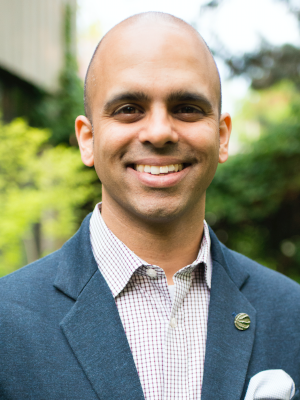
Aneil Gokhale, director of philanthropy, Toronto Foundation.
Yet, whether a family will accept public recognition can cut to the core of their values, says Katherine Bright, a consultant with Trella Advisory Group in Vancouver, which works with families and family offices.

Donors may start asking themselves, “‘What do we feel about publicity and taking more public stands? What is the risk associated with that, and does it match our tolerances?’ Those are sometimes difficult conversations.”
Major donations can attract attention of all kinds. “Some families say it is worth it. ‘I can tune it out, I can turn it off. I can manage the safety risk, and I’m going to do it.’ And other families say, ‘No, it’s not worth it. I’ll just quietly give,’” Bright says.
A common strategy with some families is to diversify beyond their normal giving or beyond the family foundation.
“One family that I’m working with, as an example, have a very large family foundation, and they have peeled off a set of funds that will be dedicated to doing different types of work that is important to the next generation, but that doesn’t necessarily fit perfectly within the mandate of the existing family foundation,” Bright says.
Giving to a community foundation, which can help take care of the administrative tasks involved in donating, may also attract less public attention than a donation from a prominent family foundation.
Charitable giving, however, can sometimes take on more of a corporate feel, with some donors wanting to see very specific results with their gifts, which can factor into the question of public recognition, says Aneil Gokhale, director of philanthropy at the community charity organization Toronto Foundation.
Some donors are saying, “‘Yeah, I want to give this gift to this charity to do X, Y and Z, because I want to see these outcomes.’ Or ‘I want to see this kind of impact, and I think that you guys can help do that,’” Gokhale says. “This is where it starts getting a bit problematic.”
Charitable groups, while of course grateful, can start feeling hamstrung. This phenomenon has in part prompted a trend back to unrestricted giving, Gokhale says.
There may also be a question of whether public recognition is even appropriate, he notes. With a women’s shelter or a food bank, for example, excessive attention to a donor’s gift or heavy corporate branding might seem tone deaf and may not be within the scope of a small charity’s resources. As Gokhale says, the story of the donation must feel genuine: “When there’s a real story behind a gift, it can help the public understand why an issue matters and why we should care about it.”
For Michael Garron Hospital, as with countless other organizations, the need remains urgent and constant, and it requires continually searching for new sources of funding.
“If you look at tax receipts, there are fewer people giving, but those individual gifts, they tend to be getting bigger,” Olmstead says. Yet, “there’s never a shortage of things that are needed, and unfortunately the hospital really has to triage. What are the most important things that they need right now? And that’s where we focus.”


The hospital’s foundation relies to a large extent on people connected with the hospital to open doors to new donors. It’s a form of public recognition on a more personal, one-to-one level, which may actually be the most important public recognition of all.
“Typically, people aren’t looking my name up to give me a call,” Olmstead says. “So, having those people who are ambassadors in our community and can speak to their network, and invite us to speak with their peers, that’s the best source.”

Guy Dixon began his career at Dow Jones Newswires in New York before joining the Globe and Mail, covering financial markets, business news, the arts and other topics over the years. He has written for the CBC and The Walrus among other publications.
Get our quarterly newsletter about philanthropy: Canadian Family Offices’ new newsletter brings you key insights, trends and expert perspectives on charitable giving, tailored to Canada’s wealth leaders and giving communities. Click here to subscribe.
Please visit here to see information about our standards of journalistic excellence.