


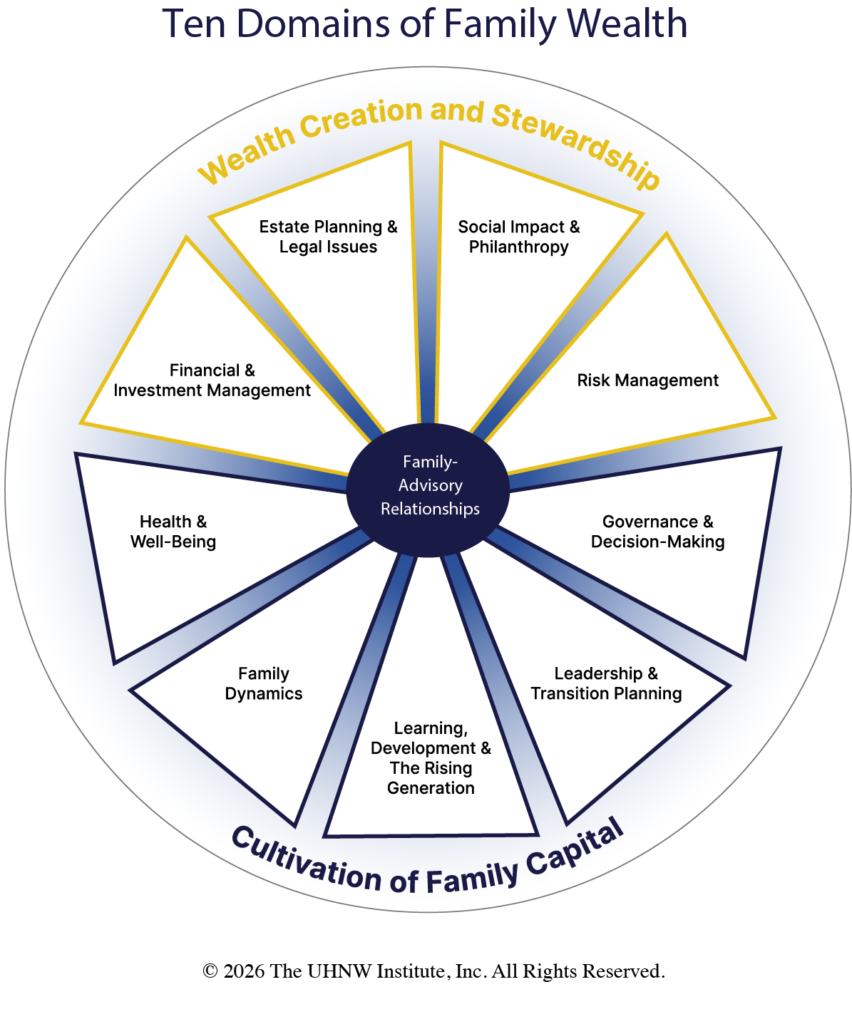
In this 10-part series, we explore the Ten Domains of Family Wealth, a comprehensive framework for understanding the issues facing wealthy families conceived by the Ultra High Net Worth Institute, headquartered in New York City. In this edition, we focus on the Health and Well-Being Domain.
New technologies, the aging population, changing attitudes towards discussing mental health and a growing trend towards longevity culture are among the factors shaping the landscape of health and well-being for high-net-worth families and their advisors.
“People with wealth have the ability to look for and ask for health and well-being options,” says Anna E. Nichols, the UHNW Institute’s Domain chair for Health and Well-Being. Based in Chicago, Nichols is also the managing director and head of client education for Altair Advisers LLC.
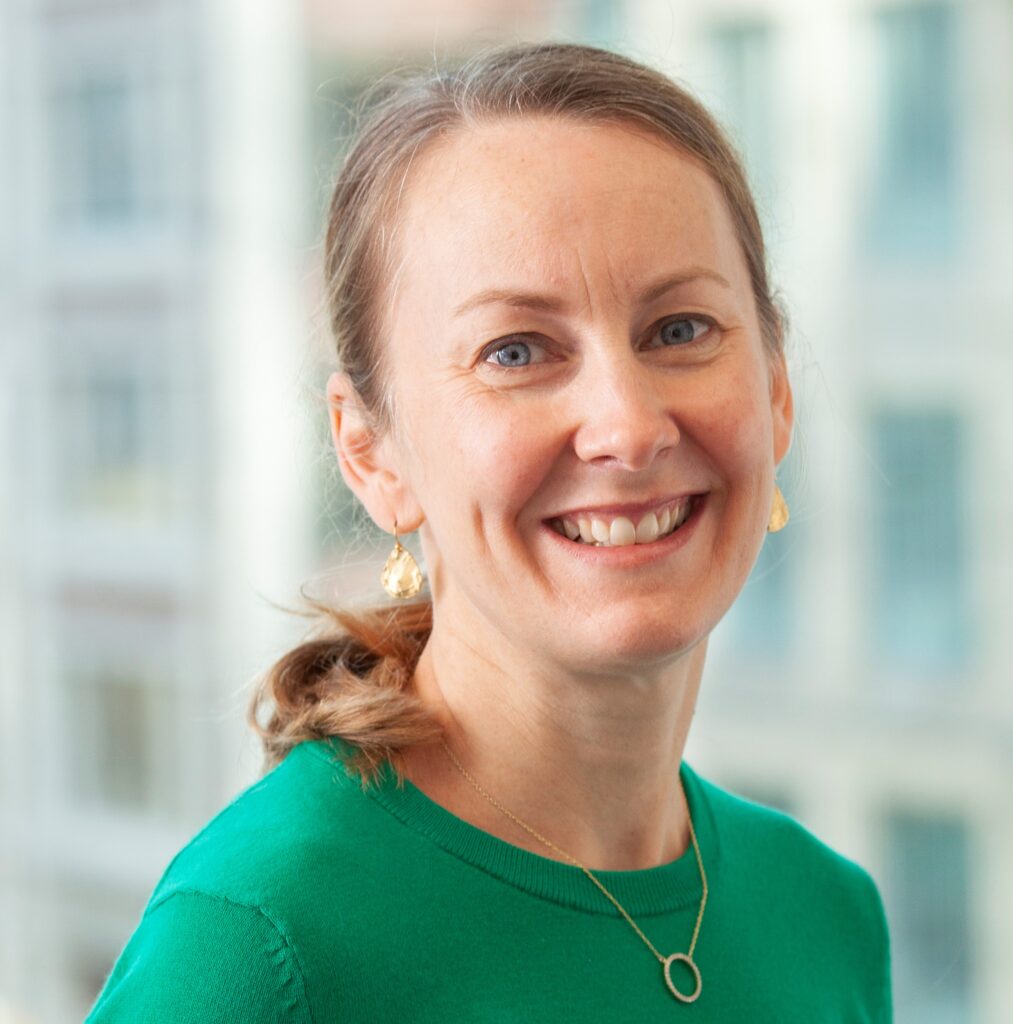
On the other hand, “sometimes wealth can separate you from good health,” she says, pointing out that people used to leading have a tendency to try to steer their own healthcare, whereas, when it comes to medical advice, “you don’t really want to be ahead—or think you are ahead—of the experts in the room.”
Nichols came to her position as Domain chair for Health and Well-Being after having led programs for Altair and other organizations about such topics as managing the care of aging parents, estate planning for family members with special needs, end-of-life care, and understanding private healthcare options.
“I talked to Tom [McCullough, the UHNW Institute’s head of Thought Leadership and Strategy], and he said, ‘I guess this is a hard Domain for you because you’re not a doctor,’” she recalls. “But you actually need someone who doesn’t have a singular perspective on the health industry. I’m coming at it as a generalist looking at all the different pieces that we do.” (Nichols discusses her Domain in detail in one of the UHNW Institute podcasts.)
Often, practitioners in general—and those in technical specialities in particular—still “don’t think of health as part of an advisory service. It is critical to get good technical advice, but whenever you are working with families you are going to be working with health issues, and those types of issues really influence financial decisions,” Nichols says.
Emerging tools like DNA analysis and full-body MRI testing (at $2,500 to $3,500 a pop) are growing in popularity as those who have the means seek to extend not only their lifespans but also their “healthspans,” the length of time a person can enjoy full physical and mental vitality. Indeed, individuals in the highest economic tiers tend to live longer than the average population. But the risk of dementia increases with age, and wealth does not necessarily offer any protection from cognitive decline, which may become a complicating factor in wealth transition.
There are all sorts of ways to help, and often when you give clients that opportunity to share with you, they’re really relieved.
Anna E. Nichols
Nichols also says more families seem to be raising issues around mental and behavioural health than ever before, whether because these issues are becoming more prominent or because clients feel more comfortable discussing them than they might have a few years ago.
In fact, Nichols says, she knows no family that isn’t coping with some type of health-related issue, such as a family member dealing with anxiety or addiction. A common challenge arises for “families with kids who’ve grown up in these very successful families, in neighbourhoods where there are very successful families around them—there’s a lot of pressure.”
Mental health “is finally getting the respect it needs and deserves, to be seen as something we have to look out for and worry about,” says Montreal-based family legacy consultant Steve Legler, who has covered the 10 Domains for Canadian Family Offices. “With things like addiction, pretending it’s not happening is probably not the best way to proceed. To have advisors who can help them have the courage and find the proper resources, that’s a huge value-add.”
But even before having the right references and referrals in place, the most important thing an advisor can do to help client families in this area is to introduce the topic early. Nichols sketches the case of a client who comes in to discuss their quarterly returns, but what they’re most concerned about is a special-needs grandson who’s going to outlive his parents.
“Maybe they don’t have the right kind of estate planning in place because they don’t know about special-needs trusts,” she says. “Before we get started, we could ask, ‘Are there any physical or behavioural health issue happening right now in the family that we should consider in the financial plan?’ Figure out how you’re going to ask, practice it, and figure out how you’re going to respond. There are all sorts of ways to help, and often when you give clients that opportunity to share with you, they’re really relieved.”
Part of the work of the Health and Well-Being Domain is gathering resources. Originally, this focused on specialists in various areas and institutions like Johns Hopkins and the Mayo Clinic, but Nichols is now reaching out to advisory firms to find out about their best practices, and whether they are covering off this Domain in-house or through outside references.
The UHNW Institute is currently assembling a members’ guide to options in healthcare, including medical specialists, specialized insurance and medevac services for people living abroad. Nichols is working with other Domains to explore new ideas in fields like genetics.
“Often, wealthy people are at the cutting edge of healthcare,” she says, noting the overlap with the Social Impact and Philanthropy Domain, as well as Estate Planning, Risk Management, Governance/Decision-Making, Leadership/Transition Planning, and Family Dynamics.
Demand for advisory competence in health and well-being is not going away. “I don’t know whether families are asking for different things or whether, as we’re getting better at asking questions, they’re thinking ‘oh, this is something my financial advisor should help me with,’” Nichols says. “Even getting people to ask that one question has been a game-changer. I think until recently they didn’t assume that we would even do anything about that.”
Sarah B. Hood is a Toronto-based writer and book author. She has served as editor of three national magazines and written weekly columns for the National Post. She also serves on the editorial board of Spacing magazine. She writes frequently on business, urban affairs and culture. As a food writer, her work has been translated into Japanese and Arabic. She has taught writing at George Brown College for more than 20 years.
Please visit here to see information about our standards of journalistic excellence.