


In a challenging business environment, private companies are asking their boards to do more to guide their enterprises through turbulent waters. At the same time, the perception of the value of those boards is declining across key metrics. And while the boards of public companies generally operate under clear governance that determines matters like chair succession, director term limits and director compensation, private boards often struggle with the same issues.
Those are among the key findings of the Private Company Director Survey, published earlier this year by Toronto- and Vancouver-based Watson Board Advisors. The results are based on a survey conducted in October 2025 by Watson, in conjunction with Compensation Governance Partners and Family Enterprise Canada, of approximately 180 privately held companies across Canada. The results were compared to a similar survey completed in 2023.
The report reveals that perceived board value has declined across 20 surveyed categories where boards could add value, including six critical metrics:
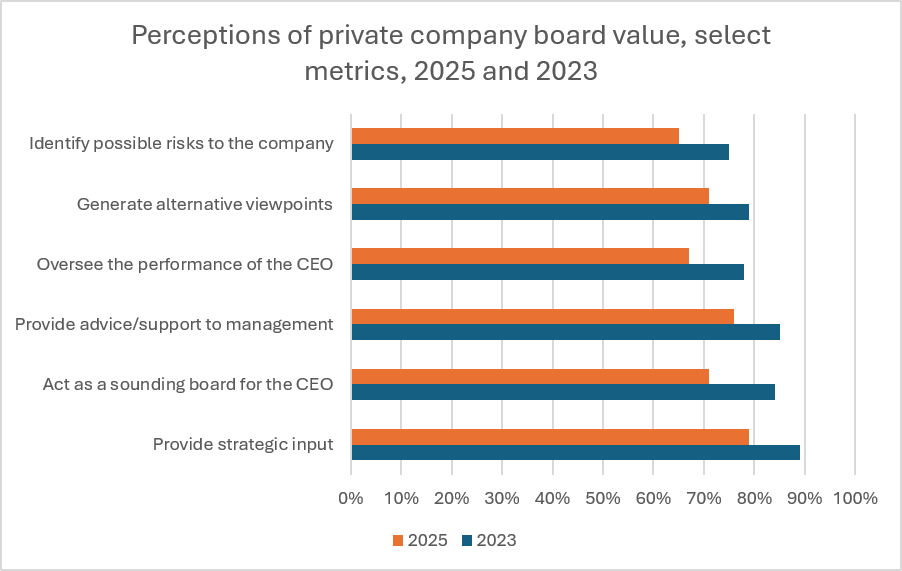
Are private boards actually underperforming, or are their contributions only perceived as less valuable? It’s a complex question, the report explains, because the environment under which boards operate has been asking more of them in light of headwinds that include a combination of external pressures—trade disruption, inflationary pressures, consolidation and heightened competition among them—as well as internal pressure tied to scale, leadership capacity and ownership transition. It may also be a case of board-member skill sets that are no longer up to the task of navigating those challenges.
“When a family business puts together a board, they may not go through the process of taking a step back and asking what skills they really need,” says Barb Schimnowsky, partner and family enterprise advisor with Watson Board Advisors. “They’re putting together a board with their accountant and their lawyer, pulling in people from their network. That may not be the best source of board members, because if you have a connection with that person, they may not want to tell you some of the hard truths or challenge you.”
Surprisingly, only 38 per cent of survey respondents use a skills matrix to guide the composition of the board. That’s not a necessity, but it helps, says Schimnowsky, citing a family that Watson assisted with board development as it looked to expand into the U.S. while it worked on a succession plan for its C-suite.
“We were looking for somebody that has expertise in a family-owned, service-oriented business, but also somebody that’s got really good M&A experience—somebody that’s maybe done scaling of a business into the U.S., and another that’s been involved in succession planning,” she says. “They would add a lot of value as this family business evolves over the next three to five years. Three to five years from now, those people may no longer be the right fit.”
Competencies and soft skills are also important, says Watson marketing lead Jenna Lightbody. Does the board have enough strategic thinkers? Are they curious? Will they challenge the board in a constructive way?
“It’s an ecosystem, where all of these people need to work together,” she says.
Making board-member exits easier
So how does a family business dispense with board members who are no longer fit for mission and replace them with people who are? Establishing clear governance and term limits can go a long way to make that process easier.
“Your first term might be a year, your second term might be two years, and your third term might be three years,” Schimnowsky says. “If you have a good chair, they may be able to give an underperforming board member some coaching and get them back on side. Term limits make it easier to refresh a board if somebody isn’t performing.”
Staggered term limits can aid succession planning and help ensure that departures don’t leave a board short of qualified personnel.
“Without term limits, you may have five veteran directors who decide that they don’t want to do it anymore and now you’ve got to fill a significant chunk of your board all at once,” Lightbody says. “That’s quite an undertaking. Intentional planning tells you whose terms are coming up, so you can gradually build your board and think more about composition.”
The survey also reveals that a whopping 78 per cent of boards surveyed don’t have a process in place to plan for chair succession. The report notes that “chair transitions are often more sensitive because the role is closely linked to owner trust, CEO support and the board’s ability to manage difficult interpersonal dynamics.”
But private businesses need to step up and create succession governance protocols. That not only helps to preserve the continuity of the board, but also allows it to maintain a state of readiness when the illness of a founder or unexpected family succession requires steady stewardship.
“Having a board with external advisors is probably one of the best insurance policies that a family business can have,” Schimnowsky says.
Show them the money
Even on matters of director compensation, private companies are often unclear on how much they need to pay to attract qualified directors. Nearly 40 per cent of private companies don’t have a set schedule to review board compensation. Another 40 per cent review it between two and five years. Although the survey report doesn’t include actual compensation details, Schimnowsky describes them as “on the low side.”
“The last few board directors we’ve done have been in the $60,000 to $65,000 range for private companies,” she says. “But if you’re pulling together three qualified directors at $180,000, that’s less than the compensation you would probably need to hire one C-suite executive. If you look at the collective of knowledge that you’re getting at the board level, you’re getting really good value for money. If you’re not, then guess what—you make changes.”
Three critical questions
Watson advises chairs and founders to ask themselves three questions to determine whether their boards can deliver value:
• Are we clear on the value our board is expected to deliver and are we measuring it?
• Do we have the right directors for the future our organization is heading into?
• Is our director compensation aligned with rising expectations?
Watson’s message is simple: Make the changes you need to whip the board into shape. If you can’t, fix the governance that will allow you to get to that better place.
Peter Kenter is a Toronto-based writer with a deep and abiding interest in how everything in the world works and how it got that way. He’s written about the economy, investing, financial services, cryptocurrency, pharmaceuticals, mining, energy, cannabis, agriculture, consumer electronics, education, sponsorship marketing, and entertainment. He’s the author of TV North: Everything You Wanted to Know About Canadian Television.
The Canadian Family Offices newsletter comes out on Sundays and Wednesdays. If you are interested in stories about Canadian enterprising families, family offices and the professionals who work with them, sign up for our free newsletter here.
Please visit here to see information about our standards of journalistic excellence.