
A mere six per cent of Canadian donors contribute a staggering 40 per cent of all charitable donations.
As referenced in a recent report published by Watermark Philanthropic Counsel, charities in Canada are deeply dependent on donations and other types of gifts from high-income and high-net-worth Canadians. But when it comes to understanding who these people are, how they think, and why they give, Canada’s charitable sector is operating in the dark.
This is a material knowledge gap. It leaves generous families without benchmarks, and it leaves charities fundamentally hindered in their ability to understand and speak to their most critical donor audience.
Limited data on wealth generally
Although we have reliable, segmented and accessible data on income and some expenditures through annual tax filings, there is no comparable information on the wealth of affluent Canadians—how their wealth is created, held, spent and, importantly, given to charities.
That said, we do know that most major charitable gifts flow not from income but from accumulated wealth held in savings accounts, GICs, mutual funds and investment portfolios of individuals, as well as giving vehicles such as private foundations and donor-advised funds (DAFs). At the end of 2024, assets held in these two charitable structures alone totalled approximately $148 billion.
Lots of estimates, no consistent methodology
Estimates (often without evidence) of the wealth and numbers of the wealthiest (the HNW segment) in this country abound thanks to information published by Statistics Canada, the Parliamentary Budget Office, leading investment firms, independent research firms and foreign banks.
It is … challenging for generous people and families to benchmark and understand what their philanthropic peers are doing.
However, there is no consistency in either the numbers or the methodology. Some HNW observers count individuals, some count households, and others are focused on families. Not only that, but some estimators look at net worth (which takes debt into account), while others deal in assets of all types, and a third group concentrates on only liquid assets, thereby avoiding the tricky areas of private equity, defined benefit pension assets and real estate. If that is not enough to confuse those who use wealth and HNW data, such as charities seeking to develop major gift strategies, some estimates are denominated in U.S. dollars while others are more patriotic and measure wealth in Canadian dollars.
To illustrate the differences between estimates caused by different approaches, one prominent international bank estimates the number of U.S. dollar-denominated millionaires in Canada to be 2,098,000. At the same time, the wealth management arm of a major Canadian independent dealer (also measuring wealth in U.S. dollars) pegs the number at 866,311.
A bit of a head-scratcher, to say the least.
Breaking down the HNW segment
Whatever the number, most millionaire-counters agree that the mass market millionaires in Canada—those with $1 million to $5 million in accumulated wealth—represent about 85 per cent of the total. The segment made up of individuals who control between $5 million and $30 million make up 11 per cent of the HNW community.
That leaves four per cent with wealth in excess of $30 million. These 15,000 or so individuals make up the ultra-high net worth (UHNW) segment that has become an increasingly visible funding source for universities, hospitals and leading arts organizations.
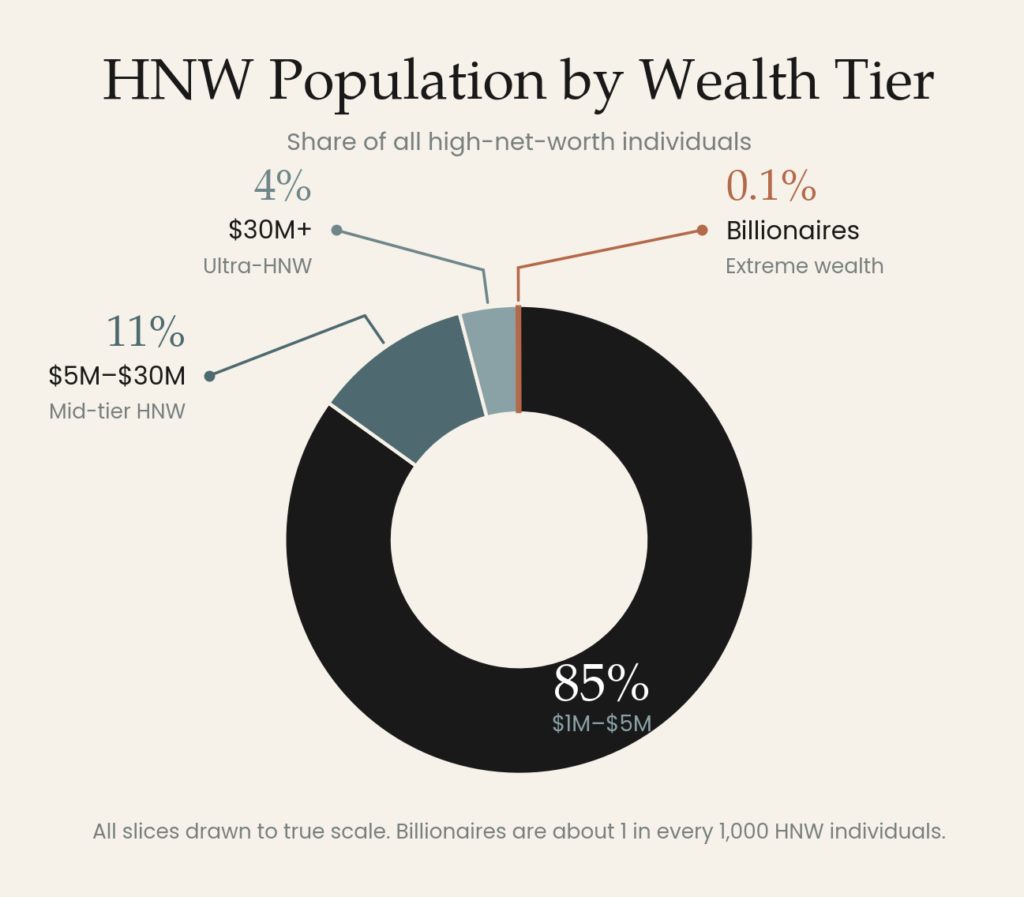
To complete the picture, Forbes magazine estimated that there are 82 billionaires in Canada, most of whom also rank among the most generous individuals and families in the country.
Understanding the HNW mind
Through Watermark’s work with generous people and families, we know that affluent philanthropists often navigate different considerations in their giving than other donors. Yet, the philanthropic sector has very few insights into what makes generous HNW and the UHNW tick; how their wealth was created (earned, gained, inherited, won or stolen); whom they take advice from; how they may or may not engage other family members in giving; their knowledge of the charitable sector, and, importantly, what drives their philanthropic and volunteer activity and decision-making.
Without these insights, it is difficult for charity executives and fundraisers to determine how best to build relationships with individuals and families with what is politely referred to in charitable circles as the “capacity” to make a major gift.
It is also challenging for generous people and families to benchmark and understand what their philanthropic peers are doing. There is growing evidence that philanthropists are looking to work together to make social investments. These donors need as much information about segment behaviour as the causes and charities they support.
Robust knowledge outside Canada
In many countries, such as the U.S., UK, Switzerland and Australia, research into the minds, habits and expectations of affluent philanthropists and generous families is undertaken not just on an occasional basis, but regularly.
Sadly, the charitable sector is still waiting for a major, objective study undertaken in Canada of HNW philanthropy.
In these countries, research is frequently funded by a single, leading financial institution or foundation, or syndicates of institutions with a common purpose. In the United States, banks such as Bank of America and Northern Trust see research funding as part of the role they play in the charitable sector. In Switzerland, UBS carries the torch, while in the UK, Barclays Private Bank recognizes the need to invest in this form of research.
And in Canada?
So, where is Canada? As far as we can tell, the last universal examination of the HNW/UHNW community, in both quantitative and qualitative terms, was undertaken by a small consulting firm back in 2004. Over the past two decades, the changes in HNW behaviour in Canada have gone largely untracked. That leaves many private sector institutions and charities having no option but to rely on U.S. research to uncover important trends which may, or may not, be reflective of developments in Canada.
Although there were some questions about philanthropy in the 2004 report, there has never been a comprehensive study of HNW philanthropy in Canada. In 2014, BMO Bank of Montreal and the Canadian Association of Gift Planners looked at the “philanthropic conversation” between advisors and generous clients, and TD has sponsored ground-breaking research into women and philanthropy. Recently, some major financial institutions and foundations came together to fund Watermark’s research into DAFs, but the study didn’t focus on the users of DAFs—wealthy Canadians.
Sadly, the charitable sector is still waiting for a major, objective study undertaken in Canada of HNW philanthropy that will examine philanthropic activity and attitudes by demographics, geography, income, wealth identity and level. To what extent do philanthropists use private foundations, charitable trusts, donor-advised funds and customized insurance products? Or what factors influence how much they decide to give and to whom? We simply don’t know.
Where is the private sector?
Why are we in this situation and lagging behind our global peers? It isn’t because major financial institutions don’t have HNW clients (over 50 per cent of whom give regularly and generously to charities), and it isn’t because those same institutions don’t have philanthropic programs designed for their clients and their clients’ children. And it can’t be that the banks, investment firms and insurance companies aren’t charitable, as they report giving, collectively, over $700 million each year.

It seems that while there is a lot of talk about social responsibility and the need to support the charitable community, not to mention the importance of meeting the wealth management needs of the affluent, there seems limited commitment to supporting the philanthropic community through research that is sorely needed to help navigate a rapidly changing environment. When asked to fund research in philanthropy and charitable giving, companies often reply “What’s in it for us?” rather than “How will this help?”
An investment, not a cost
And therein lies the problem. Funding research is viewed as a cost, not an investment with the potential for long-term impact. Research, as we know from medical and technological research, can lead to significant progress (a return on the investment) in the way we lead our lives.
Research into wealth and the philanthropy that is possible as a result of it can similarly alter the lives of many, through better services, greater understanding of the needs and interests of donors and charities, and more reliable funding at a time when governments are stepping back even as charities must respond to greater needs. This isn’t just an academic data deficit; it’s a potential funding deficit for Canadian society. There is an opportunity for the business community, particularly the financial services and wealth management industries, to join with their colleagues around the world, and fund the data that the sector desperately needs. These same businesses that recognize the value of research to the philanthropic sector will not go unrecognized by their clients, by the broader donor community, and the 85,000 charities that serve Canadian society.
Dr. Sharilyn Hale is a trusted advisor in philanthropy who helps generous people and families give with clarity and confidence, and envision a meaningful legacy. Her bespoke advisory services empower families to explore questions of purpose and values—often at times of change or generational transition. A respected author, educator and researcher, her career has spanned the philanthropic sector with a powerful blend of community experience, global practice, and sound governance principles. She serves on the Advisory Council for the Masters in Philanthropy & Nonprofit Leadership At Carleton University where she also teaches. For her significant contributions, Sharilyn is a recipient of the King Charles III Coronation Medal.
Keith Sjögren is a consultant to the charitable sector and chair of the advisory council for the Master of Philanthropy and Nonprofit Leadership (MPNL) and Diploma in Philanthropy and Nonprofit Leadership (DPNL) programs at Carleton University.
Get our new quarterly newsletter about philanthropy: Canadian Family Offices’ philanthropy newsletter brings you key insights, trends and expert perspectives on charitable giving, tailored to Canada’s wealth leaders and giving communities. Click here to subscribe now to stay ahead.
Please visit here to see information about our standards of journalistic excellence.