


Tom McCullough is partner at Corient and was the founder and chairman of Northwood Family Office. He is also Managing Director, Thought Leadership and Strategy, at the UHNW Institute, a global not-for-profit think tank.
Over the years, I’ve noticed something interesting about our profession.
We organize ourselves around disciplines. Investment advisors manage portfolios. Lawyers draft trusts and wills. Accountants focus on tax. Insurance specialists protect against risk. Governance consultants facilitate family meetings. Each profession develops its own body of knowledge, its own language and, understandably, its own way of looking at the world.
But families don’t think that way. When a family walks into our office, they are rarely looking for help with “estate planning” or “risk management.” They arrive because they’ve sold a business, a child is getting married, a parent has received a difficult medical diagnosis, siblings aren’t speaking to one another, or they simply want to know whether their wealth is preparing their family for the future or creating problems they can’t yet see.
Those conversations don’t fit neatly into professional disciplines, because life doesn’t fit neatly into professional disciplines.
That simple observation sits at the heart of what the Ultra High Net Worth (UHNW) Institute has been trying to accomplish with its Ten Domains of Family Wealth. It is also why we recently devoted one of our Corient U education sessions to exploring the framework with our Canadian advisory team.
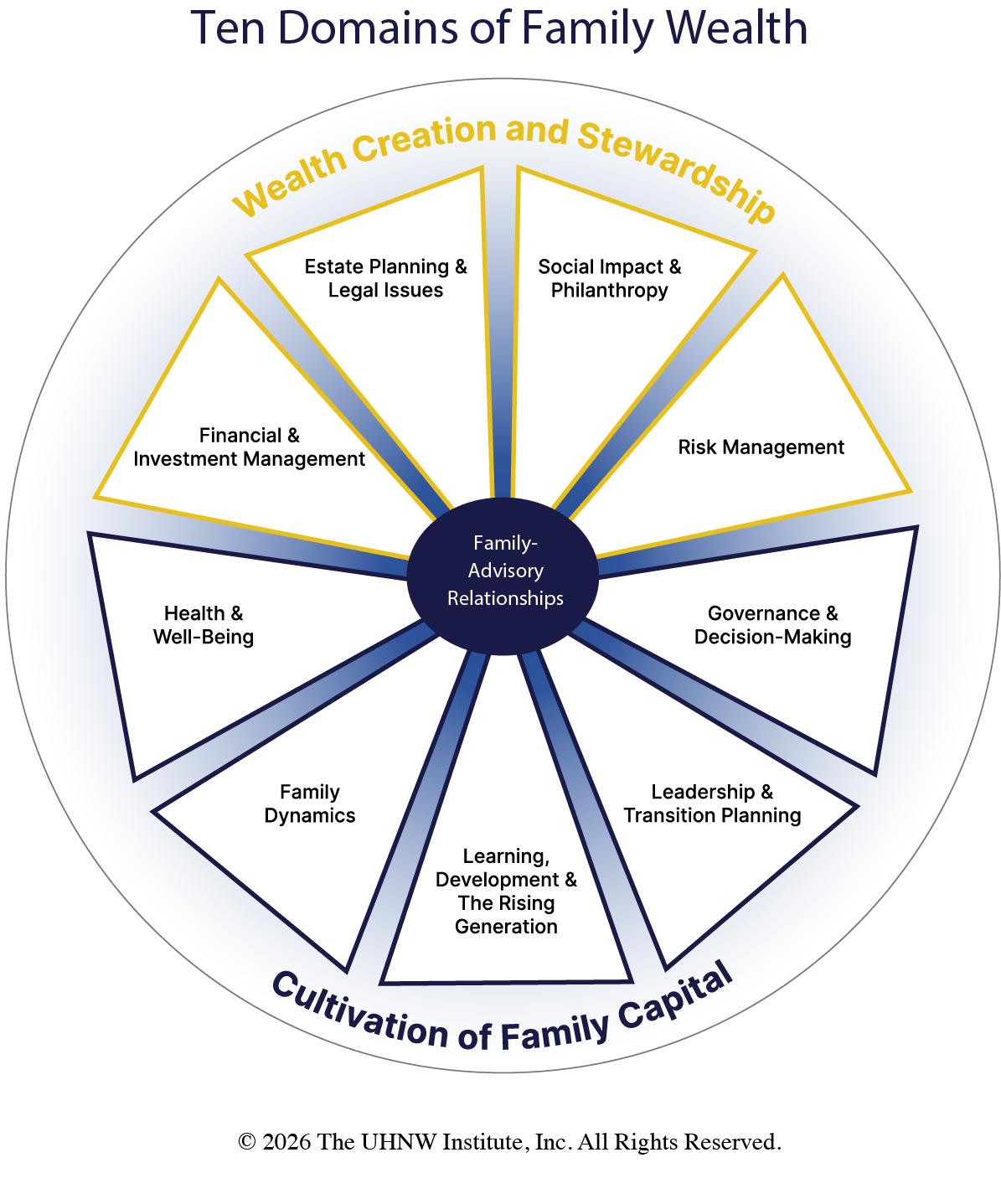
The objective wasn’t to teach another model or introduce another piece of industry jargon. It was something much more practical. We wanted our family office advisors to think even more broadly about the families they serve and to become better at recognizing the connections between issues that are often treated as separate conversations.
The afternoon reminded me that while technical expertise remains a key foundation of good advice, it is increasingly our ability to integrate that expertise that distinguishes exceptional advisors.
Looking beyond technical disciplines
At the UHNW Institute, we often explain this through what has become known as the Table Stakes framework.
Imagine a large table. The tabletop represents the full range of needs that wealthy families have throughout their lives. Those needs are organized into the Ten Domains of Family Wealth. Some are familiar to every advisor, including financial management, estate planning and risk management. Others reflect areas that have traditionally received less attention within wealth management, such as family dynamics, governance, leadership, health and well-being, learning and development, and the family-advisory relationship itself.
Of course, understanding client needs is only part of the equation. A table also requires legs.
The first leg is the firm itself. Does it have the culture, resources and capabilities to serve families well? The second is the advisor. Does that individual possess the judgment, curiosity and interpersonal skills required to work with complex families? The third consists of the services available to clients, while the fourth is the firm’s process. Can advice be delivered consistently, collaboratively and across multiple generations?
I’ve always liked the simplicity of this model because it reminds us that knowing what families need is very different from being organized to deliver it.
Many firms can describe the services they offer. Far fewer have intentionally developed the advisors, culture and processes required to integrate those services around the family’s broader objectives.
Learning from one another
Rather than spending the afternoon listening to presentations from outside speakers, we decided to make the learning at our training session much more practical.
Each advisor was assigned one of the Ten Domains. Their task was straightforward: explain what the domain encompasses, describe the knowledge and skills required to advise families effectively in that area, and then share a real client example that brought the domain to life.
That last requirement made all the difference.
Instead of discussing abstract concepts, we found ourselves talking about real families, difficult decisions and conversations that had stayed with us long after the meetings had ended. Every story reflected a different aspect of family wealth, yet they all shared one characteristic: none of them remained confined to a single domain for very long.
One presentation described a family whose wealth had increased dramatically following the sale of a privately owned business. At first glance, the engagement appeared to centre on investment management. They suddenly had substantial liquidity, multiple investment accounts, private investments, commercial real estate interests and a growing family foundation.
The more the advisor described the engagement, however, the more obvious it became that investment management represented only one piece of the puzzle. Discussions about liquidity quickly evolved into conversations about transferring wealth to adult children, co-ordinating philanthropic giving, overseeing private investments and ensuring that every part of the family’s balance sheet was working toward a common set of objectives.
Structures that once served the family perfectly can gradually become disconnected from the outcomes the family actually wants.
What struck me wasn’t the complexity of the investments—wealthy families have always had complex investments. The difference was how naturally the discussion moved across disciplines. Investment management became estate planning. Estate planning became governance. Governance became philanthropy. Before long, the conversation was no longer about managing assets. It was about helping a family use its financial capital in a co-ordinated way.
Another advisor shared a story involving the unexpected death of one of three siblings who owned a successful family business through a trust established many years earlier. Technically, the structure worked exactly as intended. The problem was that the family’s circumstances had changed while the planning had not. Ownership flowed in a way that surprised everyone involved and prompted a complete review of the family’s estate plan.
I’ve seen similar situations many times over the years. Estate plans often begin as elegant technical solutions, but families are dynamic. Children marry. Grandchildren arrive. Businesses evolve. Relationships change. Structures that once served the family perfectly can gradually become disconnected from the outcomes the family actually wants.
That discussion led to an observation that resonated around the room. Estate planning is not simply about designing good structures. It is about continually asking whether those structures still reflect the family’s objectives.
One of my favourite stories came from the discussion on Philanthropy and Social Impact.
The family wanted their giving to contribute meaningfully to climate change solutions. From a technical perspective, the work involved charitable structures, impact investing and grant-making strategies. Those topics were important, but they were not what determined the success of the engagement.
Instead, the advisor spoke about spending time listening to climate and business leaders, understanding environmental priorities and helping the family approach the work with genuine humility. The family’s willingness to learn ultimately mattered far more than the sophistication of the philanthropic vehicle.
That observation stayed with me because it reflects something I’ve increasingly come to believe about philanthropy. Technical expertise can help families deploy capital effectively, but meaningful impact almost always begins with relationships.
The final story before our coffee break involved what initially sounded like a relatively straightforward lending transaction. A client wished to borrow against a valuable collection. On the surface, it appeared to be a financing and risk management exercise. In practice, the engagement expanded into documenting ownership, reviewing insurance, obtaining appraisals, strengthening security, co-ordinating legal agreements and evaluating how the collection itself should be governed over the long term.
By then, a pattern had clearly emerged. Every advisor had arrived intending to explain a single domain. Every advisor eventually found themselves talking about several. And that, perhaps more than anything else, was the lesson the afternoon was designed to teach.
As we moved into the second half of the afternoon, the stories became even less about just technical advice and increasingly about families.
The real work is helping families discover enough common purpose that good governance becomes possible in the first place.
One advisor described working with a multigenerational family that had reached a point where informal decision-making simply wasn’t keeping pace with the family’s growth. The second generation was marrying, grandchildren were arriving, and the family’s wealth had become significantly more complex. Questions that had once been resolved around the kitchen table had become more difficult. Should family members receive financial assistance for education? How should entrepreneurial ventures be evaluated? Who should decide? More importantly, on what basis should those decisions be made?
The advisor helped the family develop what they called a family operating manual. Before anyone discussed governance structures or voting rights, however, the family spent considerable time talking about its history, its values and the purpose of its wealth. Those conversations ultimately proved to be the most valuable part of the process.
I’ve often found that governance documents don’t create alignment. They simply record it. The real work is helping families discover enough common purpose that good governance becomes possible in the first place.
Another presentation focused on a family transferring substantial wealth from one generation to the next. The accountants and lawyers were already doing excellent work designing tax-efficient transition structures. Our conversations with the family revolved around a very different set of questions.
How do you raise children who will never know a world without wealth? Should they attend public school or private school? How much help around the home is appropriate? How do parents expose children to challenge, to responsibility and to gratitude when financial constraints are no longer part of everyday life? How do family values survive when future generations will experience wealth very differently from the generation that created it?
There were no perfect answers. In many ways, that was the point. These were leadership discussions rather than technical planning exercises. The family understood that transferring capital would be relatively straightforward. Passing along sound judgment, resilience and stewardship would require far more intentional effort.
The discussion then shifted to Family Learning and Development, a domain that I believe will become increasingly important over the coming decade. One advisor spoke about a family whose wealth had increased dramatically after a concentrated equity position appreciated far beyond anyone’s expectations. Until recently, the family’s adult children had played only a limited role in financial discussions. They were building careers, establishing households and living lives that remained largely independent of the family’s wealth.
As those children entered their late 20s and early 30s, the nature of the advisory relationship began to change. Meetings gradually expanded beyond the parents to include the next generation. Conversations covered investment principles, financial decision-making, registered accounts, marriage contracts and the responsibilities that accompany significant wealth.
What I liked about this example was its timing. Too often, families begin educating the next generation only after wealth has been transferred. By then, many habits, attitudes and expectations have already been formed. This family recognized that developing future stewards should begin long before anyone inherits meaningful assets.
The Health and Well-being domain presentation reminded everyone in the room that some of the most important work advisors do has very little to do with financial markets. The advisor described a client who had recently received a cognitive health diagnosis and was understandably anxious about what the future might hold. The family’s immediate concerns extended well beyond investments. They were worried about maintaining independence, managing day-to-day responsibilities and ensuring the client remained confident in her financial affairs.
The advisory team adapted accordingly. Meetings were moved to the client’s home, where she felt more comfortable. Financial reports were redesigned into a concise one-page summary that focused only on the information most relevant to her. The team worked closely with her adult children and helped connect the family with outside professionals who could provide additional support as her needs evolved. At the same time, discussions continued around updating her estate plan and ensuring her wishes remained clearly documented.
It was a thoughtful reminder that good advice is not simply about delivering information. Sometimes it requires changing the way we deliver that advice so clients continue to feel informed, respected and in control during difficult periods of their lives.
Perhaps the story that generated the most discussion came from the Family Dynamics domain.
An advisor described a widowed client whose adult children had become increasingly involved in discussions about the family’s holding company. Everyone around the table initially focused on the technical analysis. Retaining the investments inside the corporation offered the greatest long-term tax efficiency. Restructuring the assets or winding up the company would trigger unnecessary taxes and additional costs. The math seemed fairly straightforward.
Families define success differently than advisors sometimes assume.
After the meeting, however, the advisor spoke privately with the client. He became emotional and explained that two of his children were no longer speaking to one another. He told the advisor that he no longer cared whether the corporation represented the most tax-efficient structure. If simplifying everything and distributing the assets reduced future conflict among his children, he was perfectly comfortable paying the tax.
The room became very quiet after that story. It reminded all of us that families define success differently than advisors sometimes assume. Clients often begin with the objective of maximizing after-tax wealth. But many families realize that they may also have other objectives. They want to preserve relationships, reduce conflict and leave behind a family that enjoys being together. If achieving those goals requires sacrificing some financial efficiency, many would consider that a very worthwhile trade.
The final presentation focused on the Family-Advisory Relationships domain, which I have long believed is one of the most important and least understood of the 10.
The advisor described an onboarding meeting involving three generations of the same family. As the discovery meeting drew to a close, he asked a question that I also use regularly: “Is there anything you expected us to ask today that we didn’t ask?”
The family paused before responding: “We thought you would ask us where we don’t agree.” That single question changed the entire conversation.
The discussion shifted away from portfolios and planning strategies toward issues that had never appeared on the meeting agenda. The family talked about differing views on paying private school tuition, perceptions of fairness among family branches, ongoing tensions surrounding a shared vacation property and questions about the future of a long-standing family trust.
Those issues eventually led the advisory team to add an entirely new section on family harmony and development to the planning process.
For me, that story perfectly captured the purpose of the Family-Advisory Relationships domain. Good discovery is not about collecting more financial information. It is about asking questions that help families talk about the issues that matter most but are often the hardest to raise.
The integrated advisor’s mindset
The individual presentations in our learning session were followed by a case study involving the fictional Vanderburg family. Like most good family case studies, it contained no single defining problem. Instead, it presented the kind of complexity that advisors encounter every day. A business interest, a recent liquidity event, aging parents, adult children facing different life circumstances, health concerns, charitable aspirations, incomplete estate planning and uncertainty about the future all appeared within the first few pages.
As we worked through the case, something interesting happened. Nobody spent much time trying to determine which domain an issue belonged to. Instead, the conversation naturally shifted to a different question: “What else does this affect?”
A discussion about a health diagnosis quickly expanded into succession planning, powers of attorney, estate planning and family communication. A proposed charitable gift led to conversations about governance, family values and tax planning. Investment decisions opened the door to discussions about education of the next generation, liquidity management and philanthropy. Before long, almost every issue involved four or five domains simultaneously.
I suspect that is exactly how wealthy families hope their advisors think. Clients don’t divide their lives into organizational charts or professional disciplines. They expect their advisors to recognize connections that they themselves may not see. They assume someone is thinking about the second- and third-order consequences of today’s decisions. Increasingly, they expect someone to co-ordinate those conversations before important issues fall between the cracks.


That expectation has profound implications for advisory firms. For decades, firms have primarily educated advisors by discipline. Investment professionals became better investors. Estate planners became better estate planners. Tax professionals deepened their technical knowledge. Those investments remain essential and always will.
Increasingly, however, firms also need advisors who can recognize when an issue extends beyond their own area of expertise, engage the appropriate specialists and help families navigate the inevitable intersections between disciplines.
That is one of the reasons I believe the Ten Domains are such a valuable educational framework. They provide younger advisors with a roadmap for understanding the breadth of issues that wealthy families face throughout their lives. They encourage experienced advisors to become more curious about issues outside their own specialty. Perhaps most importantly, they create a common language across the firm. When everyone understands the same framework, conversations become easier.
Nobody is expected to become an expert in all Ten Domains. That would be unrealistic. The objective is something much more practical. Advisors should recognize when a particular domain is becoming important, understand enough to ask thoughtful questions and know when to bring other specialists into the conversation. In many ways, that is what integrated advice has always been about. It is not about replacing specialists. It is about ensuring that specialists work together on behalf of the family rather than independently of one another.
As I reflected on the afternoon afterwards, I realized we had spent surprisingly little time talking about the Ten Domains themselves. Instead, we spent over two hours talking about families.
We talked about parents trying to prepare children for lives of purpose rather than entitlement. We talked about widows more concerned about preserving relationships than minimizing taxes. We talked about clients facing cognitive decline, families trying to make a meaningful contribution through philanthropy, and business owners wondering how to prepare the next generation for responsibilities they themselves had spent decades learning.
The framework simply gave us a way to organize those conversations. That, I think, is its greatest strength. The Ten Domains don’t ask advisors to change what they do best. They ask us to widen our field of vision. They encourage us to see the whole family rather than only the issue sitting directly in front of us.
I’ve become convinced that this is where our profession is heading. Technical expertise will always remain the price of admission. Families deserve advisors with deep knowledge in investments, tax, law, insurance and governance. The future, however, will belong to firms that combine that expertise with something equally important: the ability to connect it.
The most trusted advisors of the next decade will not necessarily be those who know the most about a particular discipline. They will be those who understand families well enough to recognize how all the disciplines fit together.
That was certainly my biggest takeaway from our afternoon at Corient U. We set out to learn more about the Ten Domains of Family Wealth. What we really learned was something much broader. The more we understand the interconnected nature of family wealth, the better equipped we become to help families navigate the opportunities and challenges that accompany it. Ultimately, that’s what integrated advice has always been about.
The Canadian Family Offices newsletter comes out on Sundays and Wednesdays. If you are interested in stories about Canadian enterprising families, family offices and the professionals who work with them, you can sign up for our free newsletter here.
Please visit here to see information about our standards of journalistic excellence.