
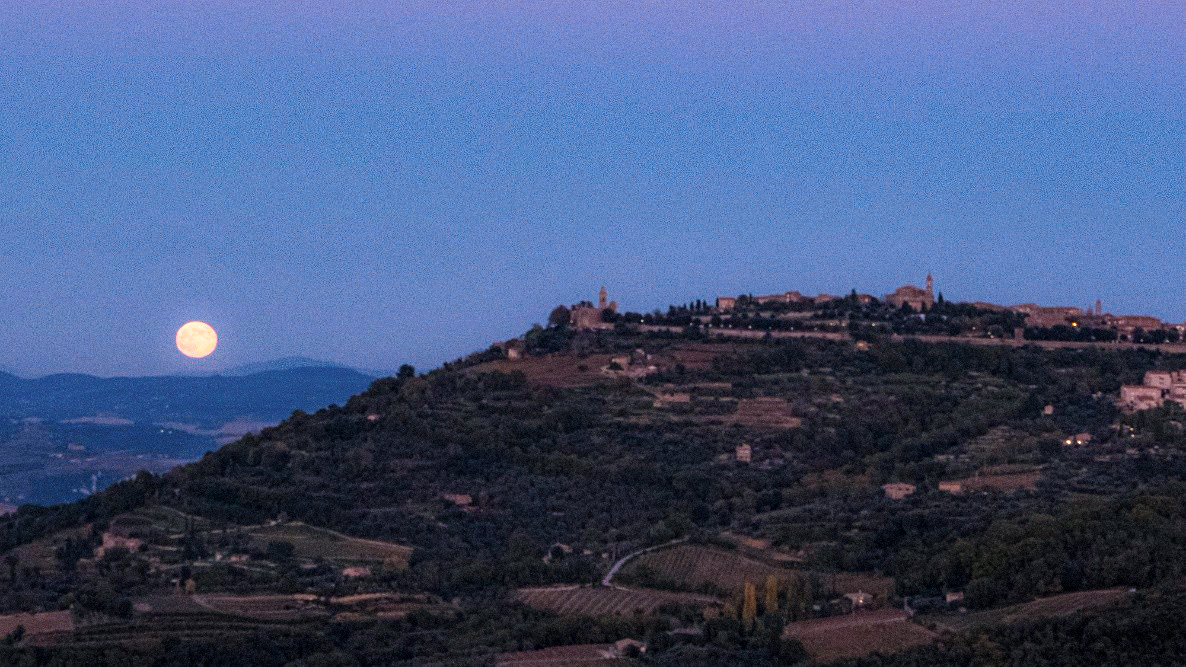
Montalcino is the postcard-perfect Tuscan hill town of the imagination, a jewel of medieval architecture once considered an impenetrable stronghold. Its massive walls and great fortezza, still standing today, were built from the sandy brown pietraforte stone quarried locally, the same rock that underlies many of the region’s finest vineyards. When Florentine Cosimo de’ Medici took the town in 1559, it was the last independent municipality in Italy.
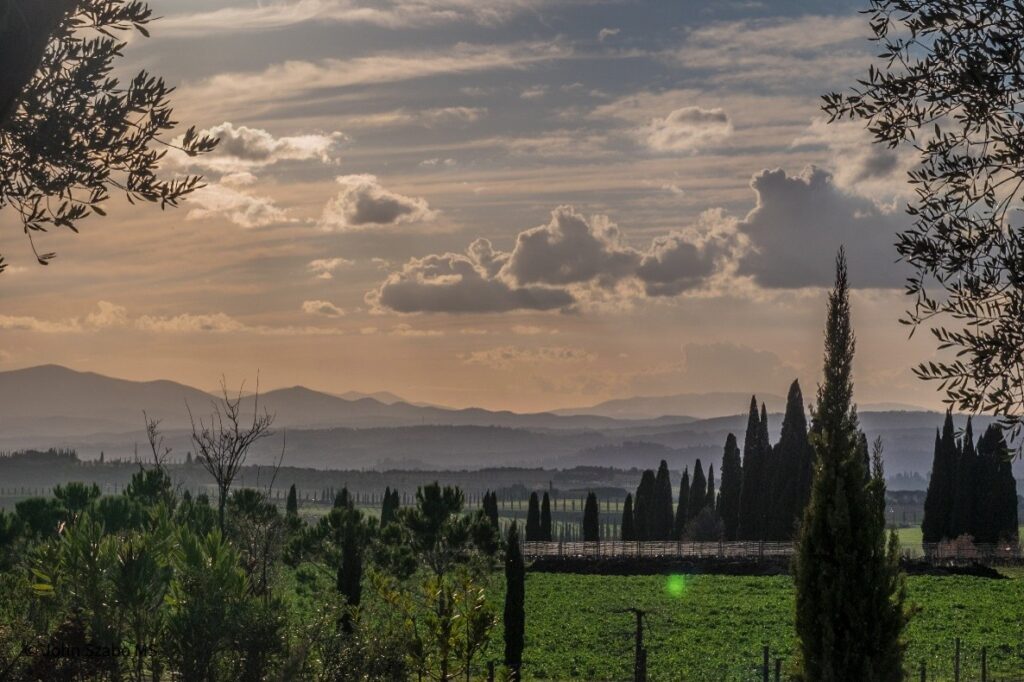
The name derives from Mons Ilcinus, the Mount of the Lecci (or holm oaks), as the trees on the town’s coat of arms suggest. Some 40 km south of Siena, Montalcino surveys the Val d’Orcia to the east and the Tyrrhenian Sea to the west. Vineyards blanket the hill on all sides and stretch south past the Abbey of Sant’Antimo, with the extinct Monte Amiata volcano in the distance.
“Montalcino is not particularly famous, except for the goodness of its wines,” wrote English traveller Charles Thompson in 1744. Nearly 300 years later, it ranks among Italy’s most celebrated towns, and for precisely the same reason.
Modern Brunello traces back to Clemente Santi, who established the Biondi-Santi estate and whose 1865 vintage turned heads as far away as Paris. But it wasn’t until the second half of the 20th century that Brunello di Montalcino became an international symbol of fine Italian wine. In 1980, it was the first Italian wine granted DOCG status—the summit of the national hierarchy. Fame followed swiftly, and more than 200 producers now bottle their own wine.
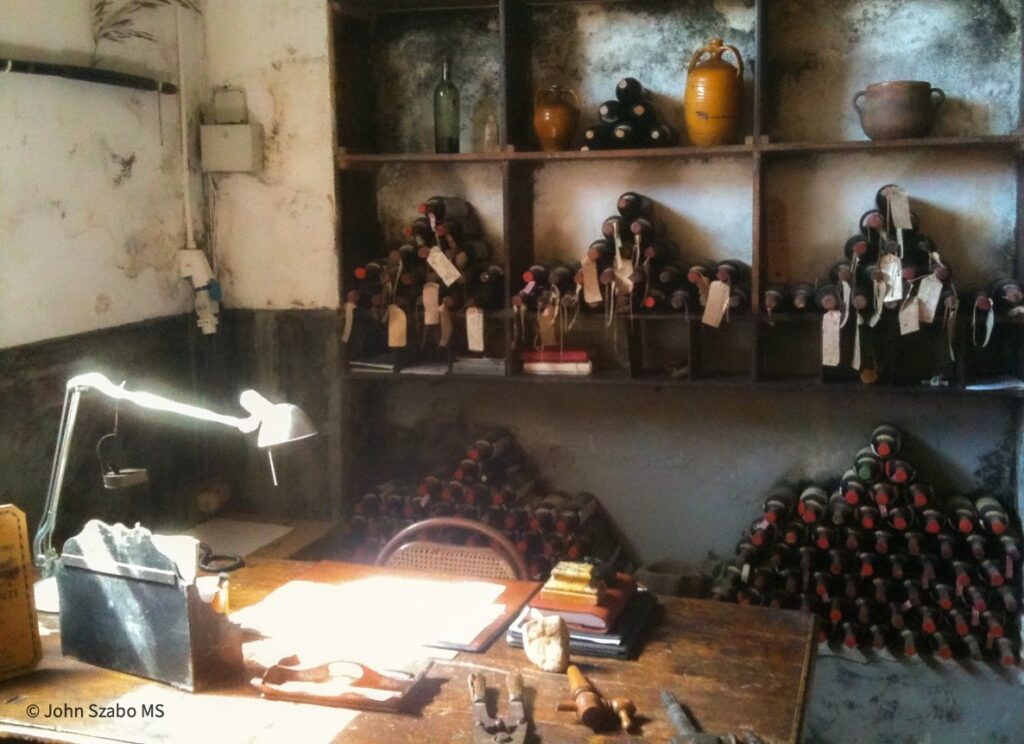
“The success of Brunello stems from years of dedicated work,” said Count Francesco Marone Cinzano of Col d’Orcia, a founding member of the Consorzio Brunello di Montalcino, formed in 1967. “In 1974, only 75,000 bottles were sold. By 1980, sales exceeded 400,000. The DOCG recognition was a pivotal moment.”
The appellation is essentially a single hill, a 17-by-18-km block of southern Tuscany with the fortified village at 564 metres and vineyards spilling down all four flanks. Some 44 per cent of its 24,000 hectares remains woodland, a cooling buffer that matters more every year.
Monte Amiata shelters the zone to the south and channels breezes from the Tyrrhenian, while the Orcia, Ombrone and Asso rivers frame the territory. Soils are mainly sandstone-derived, with less limestone than in Chianti Classico.
Traditionally, the cooler north and northeast, Montosoli included, have yielded the fresher wines and the south and southwest around Castelnuovo dell’Abate and Sant’Angelo in Colle the more powerful ones, though the distinction is blurring as the climate warms. Every Brunello is 100 per cent Sangiovese.
Montalcino pioneered wine tourism in Italy, with some of the country’s first open cellars and guided tours, and it remains a superb base for a few unhurried days. Spring and early autumn, when the harvest is under way, sidestep the summer crowds.
Where to stay
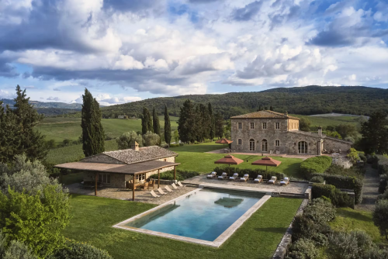
Rosewood Castiglion del Bosco, the Ferragamo family’s sprawling estate on the edge of the Val d’Orcia, is a restored historic borgo with its own Brunello winery, an 18-hole golf course, a spa and private villas with pools—well suited to multigenerational travel. Castello Banfi Il Borgo, a Relais & Châteaux property of just 14 rooms beside a medieval castle on the Banfi estate, puts Brunello at the door, with winery tours and tastings included and Michelin-starred dining at La Sala dei Grappoli. For a restorative stay, Castello di Velona, a hilltop castle resort above the Orcia valley, pairs its own vineyards with a thermal spa.
Where to eat
In town, Il Giglio, a family-run hotel and restaurant on Via Soccorso Saloni, is a dependable address for traditional Tuscan fare: hand-rolled pici, ribollita, wild boar scottiglia with polenta and veal braised in Brunello, served by a roaring fireplace with countryside views and backed by an extensive wine list. For the evening passeggiata, head to Alle Logge di Piazza, beneath the loggias of Piazza del Popolo and the town’s rallying point for Brunello drinkers. Take an outdoor table under the clock tower, order the pici with guanciale and crispy onion, and let the sommelier steer you through a deep list of local producers.
The 2021 Brunello vintage: Fragrant, refined, and not quite slender
In mid-October, I attended the annual Benvenuto Brunello roadshow in Toronto, a showcase of current releases: the 2021 annata and the 2020 Riserva. The 2021 vintage is excellent and well worth the cellar space.
The Consorzio has retired its star ratings in favour of “Brunello Forma,” which ascribes each vintage three descriptors distilled from weather station data, lab analyses and a panel of Masters of Wine. For 2021, the words are “fragrant,” “refined” and “slender.” I’ll sign off on the first two.
The season
On paper, 2021 should have been tough: the second-driest growing season of the past 30 years after 2003, with a hot, dry September and frosts in early April that hit low-lying vineyards hard. Yet severe heat stress never arrived. “It was one of the very few vintages of the last 10 years in which it was very easy to be a winemaker,” Alessandra Angelini of Altesino and Caparzo told me. “We had the rain when we needed the rain.”
Late pruning was frost insurance for the patient; Capanna didn’t start until March. “If you’re a risk-taker and you prune early,” warned Gabriele Casagrande of Capanna, referring to the vine’s tendency to bud earlier if pruned early, “spring frost is waiting for you behind the corner.”
Losses were real but localized. Brunello Consorzio president Giacomo Bartolommei puts the appellation-wide reduction at 10 to 15 per cent, or roughly eight million bottles against a normal nine.
Where does 2021 sit? The consensus places it between 2016 and 2019. “You know it’s a big vintage. You know it will go on forever,” says Angelini. Bartolommei is more guarded, calling 2021 “just a step down from 2019 and 2016,” though he credits it with “a sort of readiness in a first approach.” Marco of Silvio Nardi offered the wisest perspective: “You see a good producer in a bad vintage, not in a good vintage.”
The wines
Across some 30 2021s tasted, the common thread is perfume: pure cherry, wild Mediterranean scrub and resinous herbs, often with black tea and orange zest. Tannins are fine and polished, acids succulent and sapid, keeping the wines fluid despite considerable extract. The best are surprisingly open now yet clearly built for the long haul.
Slender, though, they are not. Most labels declare 14.5 per cent to 15 per cent, and a few reach 15.5 per cent. “Here we are at 15, but you don’t feel it so much,” Fabien Schwartz of La Magia told me.
In the best wines, that’s true. In the outliers, alcohol shows as warmth and the occasional raisined note, more reminiscent of the hot 2015 vintage. Producer selection matters.
Collector’s guide: six wines for the cellar
98 GIODO BRUNELLO DI MONTALCINO GIODO 2021 Tuscany
$N/A Le Sommelier Inc.
Podere Giodo is the personal project of celebrated Italian consultant Carlo Ferrini, who in 2002, after years of searching, bought this property in southern Montalcino between Sant’Antimo and Sant’Angelo in Colle. Both the Giodo bottling and the entry-level Prètto Brunello share the same vineyards; the most harmonious, age-worthy lots, from large French tonneaux, are reserved for Giodo, first released with the 2009 vintage. Tannins are like ribbons of silk framing perfectly composed red fruit and herbal spice. Don’t be deceived by the delicacy: it packs considerable power, a background hum that will keep humming into the early 2040s. Magnificent wine, full stop.
96 ALTESINO VIGNA MONTOSOLI 2021 Tuscany
$189.99 Rogers & Company
Altesino’s Montosoli vineyards budded late and escaped the April 2021 frost, so volumes were near normal. Alessandra Angelini places it between 2016 and 2019, with the approachability of the former and the depth and structure of the latter. Supple now yet dense and concentrated, with a wash of dark cherry and fine-grained tannins. Length is outstanding. Top-notch Brunello, best 2027–2040+.
96 CASANOVA DI NERI GIOVANNI NERI DI CASANOVA DI NERI 2021
$509.95 Halpern Enterprises
A new vineyard for Casanova di Neri (first vintage 2019), with vines already a half-century old in the southeast of the appellation, named for the estate’s founder. Fermented with 20 per cent whole clusters and native yeasts; 14.5 per cent declared. Broad, full and generous, with fine polish, excellent depth and length, and succulent acids driving through the finish. Marvellous wine, best from 2028.
96 DONATELLA CINELLI COLOMBINI PROGETTO PRIME DONNE 2021
$N/A Le Sommelier Inc.
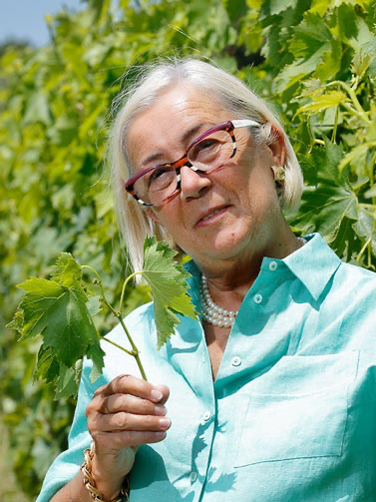
Chosen by a panel of four women, including Masters of Wine, Prime Donne is the flagship of Casato Prime Donne, where everyone from cellar crew to winemaker is female. The 2021 is riper and denser than the regular Brunello, with a strong mineral core, palate-warming alcohol and a very long finish: power with refinement, and a sapidity that compels another sip. Outstanding.
95 CAPANNA RISERVA NICCO CAPANNA 2021
$N/A Con-Nois-Seur Wine Imports Inc.
A single-vineyard selection from old Sangiovese vines on Capanna’s Montosoli hillside, aged in large, old Slavonian oak casks and named for Angelo ‘Nicco’ Cencioni, father of founder Giuseppe. Intensely structured, dense and complete, with red and darker cherry fruit, savoury herbs and earth. Abundant tannins are coated in extract, and length is excellent. Give it another three to four years; it will hold into the 2040s.
95 CAPARZO BRUNELLO LA CASA 2021
$147.95 The Case For Wine
La Casa is a five-hectare vineyard at 275 metres on the Montosoli hill, first bottled separately in 1977 as one of Montalcino’s first single-vineyard Brunellos. The 2021 is stylish, fluid, ripe and modern, with lovely aromatics and high concentration. Supple, plush tannins are framed by zesty Sangiovese acids, leading to a long finish. A polished, complete wine, drinking well already; hold into the late 2030s.

The Canadian Family Offices newsletter comes out on Sundays and Wednesdays. If you are interested in stories about Canadian enterprising families, family offices and the professionals who work with them, but like your content aggregated, you can sign up for our free newsletter here.
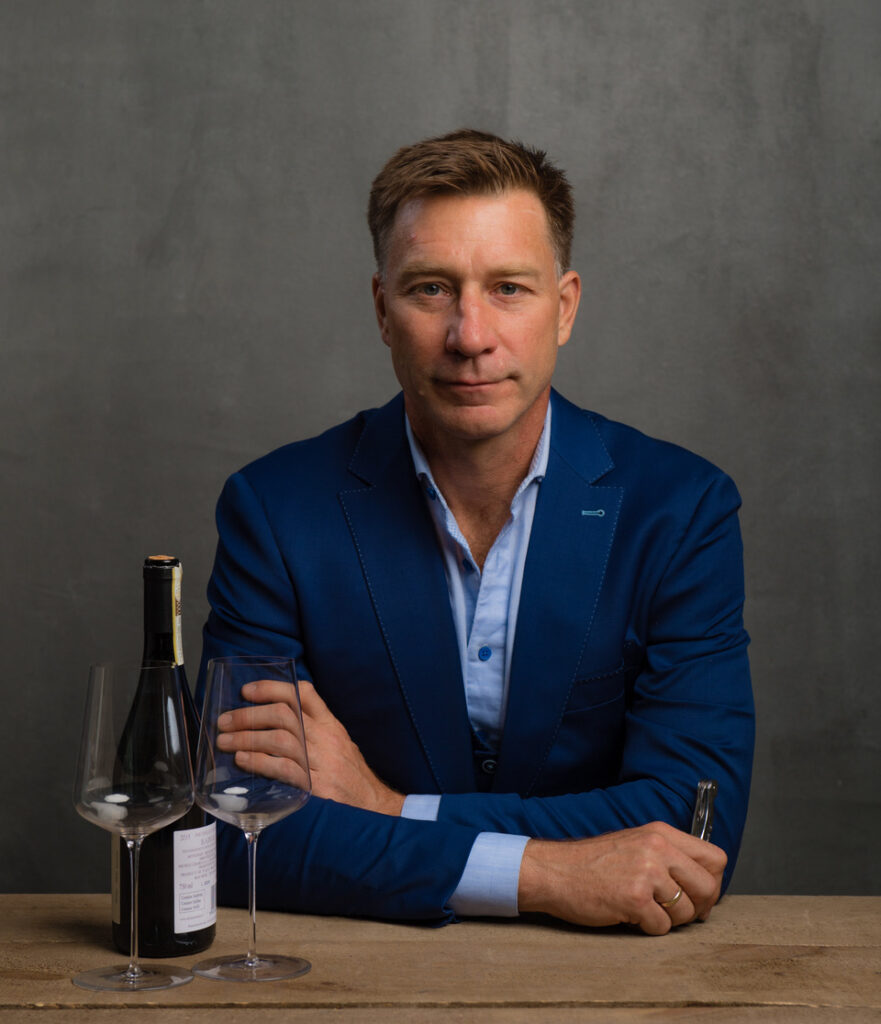
John Szabo is Canada’s first Master Sommelier and one of the best-known Canadian voices in wine. He is a principal critic for WineAlign.com and Curator-in-Chief for the WineAlign Exchange, which offers members a curated case of fine wine quarterly.
Please visit here to see information about our standards of journalistic excellence.