

Canadian multi-family offices are deeply concerned about cybersecurity—but they don’t see much need to invest in it going forward. MFOs are also really worried about hiring and retaining the talent to effectively support their client families, not just because of competition from other players in the financial services industry, but also because the right mix of technical and client-relations skills is hard to find.
Those are just two of the insights in Canadian Family Offices’ latest MFO study, The Multi-Family Office Landscape in Canada 2026, which is now available for online reading or download. The study is based on a survey of 79 MFO representatives who responded to 24 questions about their firms’ characteristics, client wealth, investment allocations, top priorities and challenges, and revenue models. (That response base is up from about 50 back in 2024, when we first launched the survey.) As well, for the first time, we complemented the online responses with one-on-one interviews with MFO leaders, providing more context and in-depth insight to many of the issues our study explores.
Another change this year was the way we asked respondents about their concerns. In the past, our survey gathered opinions about a range of external factors—from tax policy to geopolitical turmoil—and how worried MFOs were about them. In this year’s survey, we set aside the macro discussion (in part because tax policy was the perennial top concern and we didn’t see that likely changing) and instead asked about the most pressing challenges MFOs themselves encounter to their operations and growth prospects. And to get a read on the other side of the MFO equation—families—we asked about the most significant challenges their clients face.
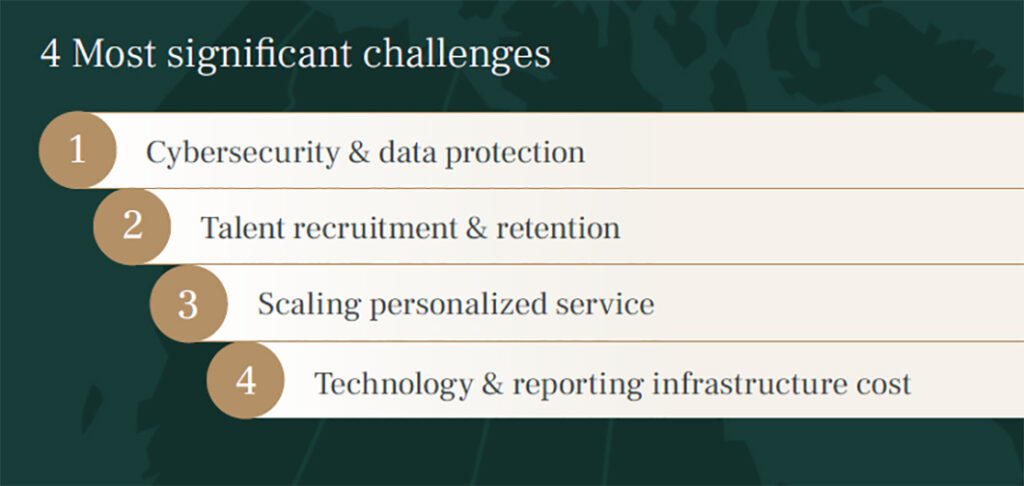
Cybersecurity: A gap between threat and response?
The answers were revealing. We asked MFO leaders to rank nine issues on a scale from “Not a concern” to “Critical,” then calculated the weighted average of the responses on a five-point scale. Given the high-profile and growing instances of information breaches, tech outages and AI deepfakes—and the fact that more than one in five survey respondents said their offices had been targets of a cyber incident over the past year—it is hardly surprising that cybersecurity and data privacy infrastructure emerged as the top MFO concern. As one MFO leader put it, “Our doors are being knocked on daily, apparently by hundreds of scammers.”
How are MFOs responding? When we asked about where they had made their most significant technology investments over the past two years, about 40 per cent said cybersecurity and data protection tech—fifth in our list of seven technology areas, with AI-driven analytics and personalization tools coming out on top, at 71 per cent. What also stands out is that when we asked where they see themselves making the most significant technology investments over the next year, none identified cybersecurity enhancements. (AI came out on top here, too.)
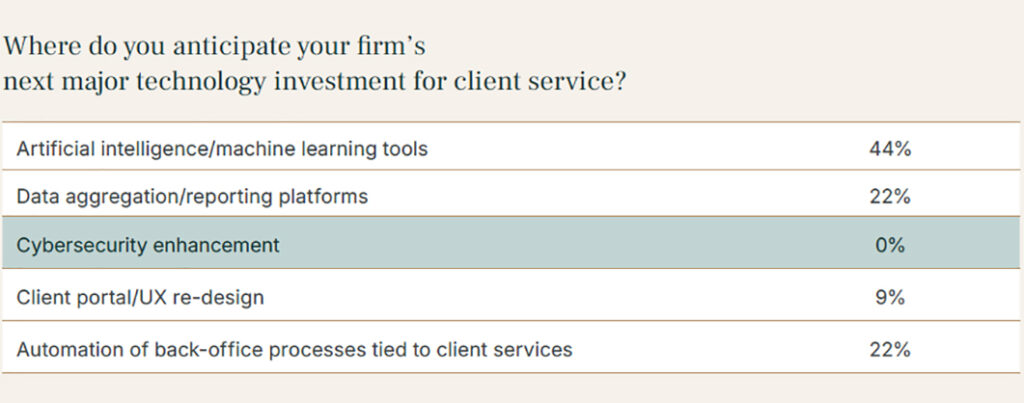
Given the severity of the threat—and given the rapidly evolving capabilities of cyber criminals, fuelled in large part, ironically, by AI—these levels of past and planned investment appear remarkably low.
The talent crunch
The second most significant challenge among respondents in our survey was something of a surprise: talent recruitment and retention came out ahead of scaling personalized service, technology and reporting infrastructure, fee/margin pressure and other issues. In our interviews, several MFO leaders pointed to sharp competitive pressures from other financial services-oriented firms, especially for technical talent. (One accounting-centric MFO noted that young employees are perennially poached by the Big Five firms.)
But the talent challenge also has to do with something of particular concern to family offices: finding the right mix of technical and people skills in job candidates. In interview after interview, MFO leaders told us that they look for employees who not only have the right credentials in, for instance, investment management, but also can navigate family dynamics and communicate effectively across generations. “Our challenge is that we are pretty particular about who we hire,” said one MFO executive. “The people we hire have to be very good with people. They can’t just be good technicians.”
The scarcity of candidates and the selectivity of MFOs is related to the third most significant challenge: scaling personalized service. As family offices grow, technical services are relatively easy to scale, but managing complex interactions and providing high levels of service become more challenging. “Scaling service levels feeds into talent recruitment and retention,” an MFO leader noted. “When you have the right people, the high-touch service approach is great, but it’s difficult to find these unicorns who have skills in a number of different areas and disciplines.”
Are the kids all right?
When we asked MFOs to identify the most significant of nine challenges their clients’ face, the top responses covered a wide range. But they share one key characteristic: they all have to do with intergenerational family dynamics and the next generation.
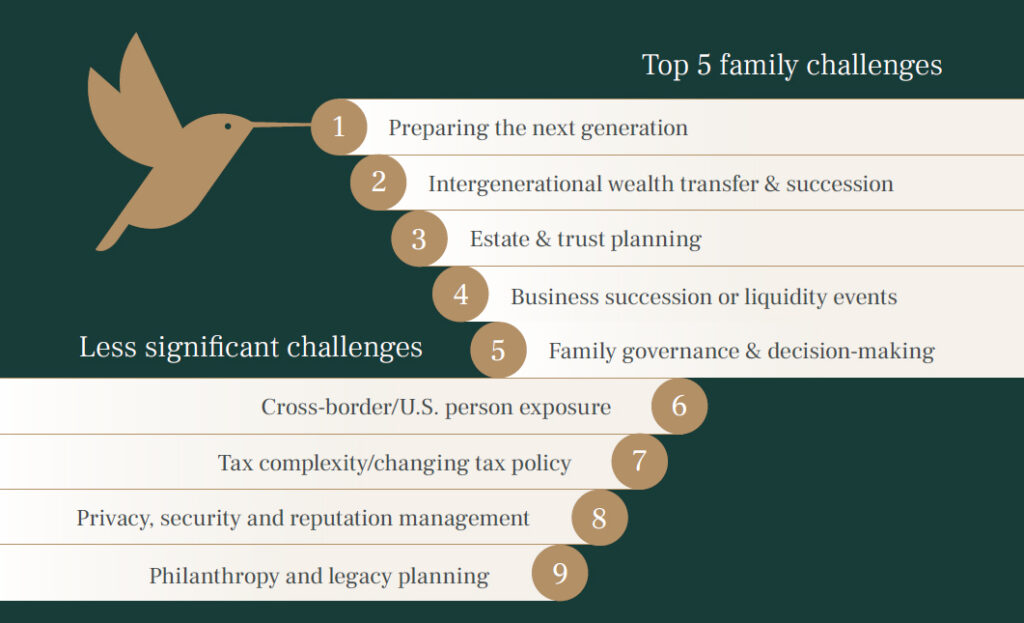
Preparing the next generation to take on the responsibilities of family wealth was cited as the most pressing challenge, but the Top 5 included intergenerational wealth transfer, estate and trust planning, and business succession. A lack of planning for succession and preparing the next generation is a common finding in surveys even of single-family offices (for instance, UBS’s most recent Global Family Office Report), and our survey may imply a similar need to address the issue among MFO client families.
In our interviews, MFO leaders frequently said that many families are often unprepared to have the conversations needed to address next-gen preparedness and the transfer of wealth and control. “Obviously, every family is different,” said one executive, “but we often see these types of discussions around next-gen and succession done later rather than sooner.”
The good news is that MFOs are working hard to address the need. When we asked them about a range of services that they provide in-house, outsource or don’t offer at all, the service most offered in-house was family governance and education (78 per cent), followed closely by estate and succession planning. More than 90 per cent of surveyed MFOs offer these services either in-house or on an outsourced basis—interestingly, more than the percentage that offer investment management and advisory.
Read the full report
Our study reveals many more insights into Canadian multi-family offices, including their staffing, client family wealth, assets under management/administration, revenue models, services offered and investment allocations. As with our previous studies, the results of the survey are intended to be directional rather than definitive, but our goal is to help round out the collective understanding of MFOs in general and Canadian MFOs in particular—a subset of the family office landscape that often goes overlooked in industry research.
You can now read the 2026 Multi-Family Office Landscape in Canada study online or download the PDF version. (Registration required.) As always, we welcome comments, criticisms and other forms of feedback. Please address those to newsroom@canadianfamilyoffices.com.
Joe Chidley is Managing Editor of Canadian Family Offices.
Please visit here to see information about our standards of journalistic excellence.