


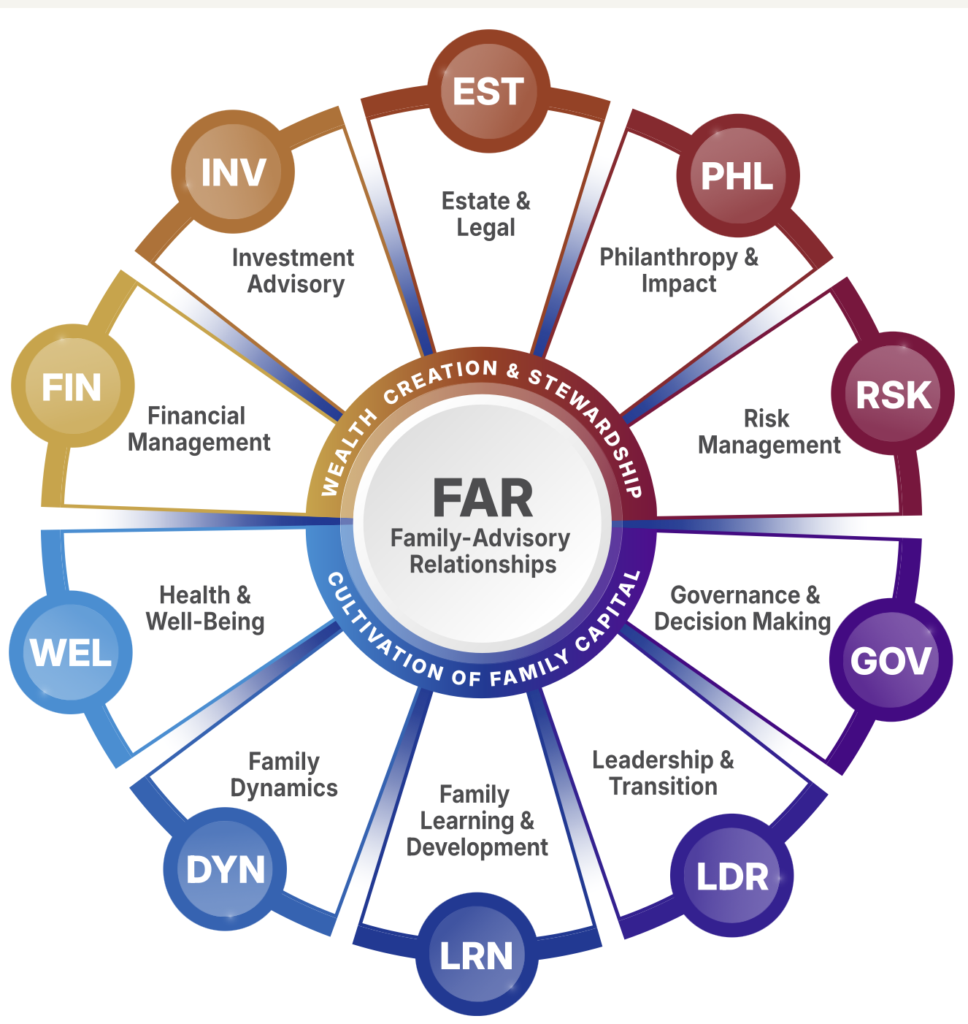
In this ten-part series we explore the Ten Domains of Family Wealth, the comprehensive framework for understanding the issues facing wealthy families, as conceived by the Ultra High Net Worth (UHNW) Institute, headquartered in New York City. In this edition, we focus on the Governance and Decision-Making Domain.
In a business setting, it’s usually not too hard to understand who gets to make decisions and who doesn’t. There’s a clear distinction between personal belongings and company property, and a business meeting is different from lunch with a co-worker. But in an enterprising family, it’s up to the family members to define it all: ownership status, a constitution, policies, meeting rules, board make-up and of course mechanisms for conflict resolution.
The Governance & Decision-Making Domain encompasses all of this; it’s concerned with the structures and processes families use to manage themselves within and across generations. Along with Leadership and Transition Planning; Learning, Development and the Rising Generation; Family Dynamics, and Health and Well-Being, it is one of five domains in the Cultivation of Family Capital cluster, which addresses the non-financial dimensions of family wealth.
Start with governance

“Governance is the operating manual for a complex family enterprise, which is made up of both a family and extended family,” says Dennis Jaffe, a senior research fellow with BanyanGlobal and Domain chair for Governance and Decision-Making, who is based in San Francisco. (He discusses his Domain in the fourth episode of the UHNW Institute Podcast.)
The challenge with family governance, he says, is that it deals with both “a personal social system and a business financial social system; it’s very unusual in the fact that they are both operating together, and it gets very complicated when there are two or three generations.”
Advisors in the area of governance must assist the family in creating an entity that is both a business and a family, whose members are able to take on appropriate roles and make effective decisions.
“What is a decision, and then who is the decision-maker? Who participates in the decision-making, and who makes it happen?” Jaffe asks. “If you’re a 15-year-old kid, you’re not a decision-maker about finance, but you may be a decision-maker about family meetings.”
The complexities that come with governance
Governance becomes increasingly complex as the family expands with the addition of children and spouses; it overlaps with issues of inheritance, and it’s subject to upheaval with triggering events like the death of a founder or the sale of a core business.
“The big thing that we talk about is that families want to do things improvisationally and not make rules—and it is kind of strange to say that we have to make rules and have meetings,” Jaffe says. “Generally there’s an avoidance and a resistance, and though people say they want to do it, their feet don’t move.”
Jaffe is probably best known within the family-advisory field as a co-author, with Jim Grubman and Kristin Keffeler, of Wealth 3.0: The Future of Family Wealth Advising, published in 2023 and considered by many to be a must-read for contemporary practitioners. He also wrote 2020’s Borrowed from Your Grandchildren: The Evolution of 100-Year Family Enterprises, which explores how large, long-lasting business families succeed across generations, based on his observation of almost 100 global business families.
Jaffe, who holds three degrees from Yale, worked in organizational change after receiving his doctorate; not only mergers and acquisitions, but also helping families deal with culture shifts. His career evolved along with the field of family advising.
“In the late ‘70s, there was no field of family studies; it didn’t exist,” he says. Thus, when he was approached to teach at the University of Southern California, he broke ground as an instructor of family dynamics and change management. Since then, he has been in demand globally, becoming a leading voice in a sector he has helped create.
As the field has developed, new tools have been created to help families and their advisors to demystify the complexity. For many years, a helpful concept for practitioners working in the governance arena has been the Three-Circle Model, developed at Harvard Business School by Renato Tagiuri and John Davis in 1978. It clarifies the complex connections at play within enterprising families by focusing on three overlapping areas: family, business and ownership.



New concepts that help advisors and families
Jaffe notes that a newer iteration of this concept has emerged within the past few years. The Four-Room Model was developed by Josh Baron of Harvard Business School and Rob Lachenauer of BanyanGlobal, co-authors of the Harvard Business Review Family Business Handbook. It describes the family-business system simply as a home with four rooms: an Owner Room, a Board Room, a Management Room, and a Family Room, each with its own rules. (Baron describes the model in an episode of Steve Legler ‘s Let’s Talk Family Enterprise podcast.)
The UHNW Institute faculty involved in this Domain have programmed several events for its members through 2026. In July, Jaffe presented the first of a two-part virtual masterclass with consultant Pat Armstrong and Rebecca Meyer of Relative Solutions. Titled The Awakening of Family Governance — Evolution of Family Enterprise After the Founder, it examined how governance shifts from informal decision-making to structured collaboration as families move from founder-led to multi-generational leadership and what advisors can do to guide that evolution most effectively.
The second part, scheduled for October 8, focuses on established governance structures. The content from the two sessions will be captured later in the form of a white paper.
In November, the Institute’s Single Family Office (SFO) Circle is offering a masterclass in New York City called The Journey from Intention to Action: Planning for Governance Succession in SFOs. It will be led by Jaffe with Amy Renkert Thomas and Meredith Straight of Renkert Thomas Consulting.
When it comes to family governance, the only thing that’s certain is that it has to be customized for every family. “Everybody has a different way of looking at governance, depending on their history and their mindset; it’s not cut and dried and rational,” Jaffe says. No matter how onerous the process, he advises to just keep going.
“The word ‘resistance’ is an example: what it means is there are some people who don’t agree with me. You can have different opinions, but you have to work it out or you won’t be able to work together.”
Sarah B. Hood is a Toronto-based writer and book author. She has served as editor of three national magazines and written weekly columns for the National Post. She also serves on the editorial board of Spacing magazine. She writes frequently on business, urban affairs and culture. As a food writer, her work has been translated into Japanese and Arabic. She has taught writing at George Brown College for more than 20 years.
Please visit here to see information about our standards of journalistic excellence.