

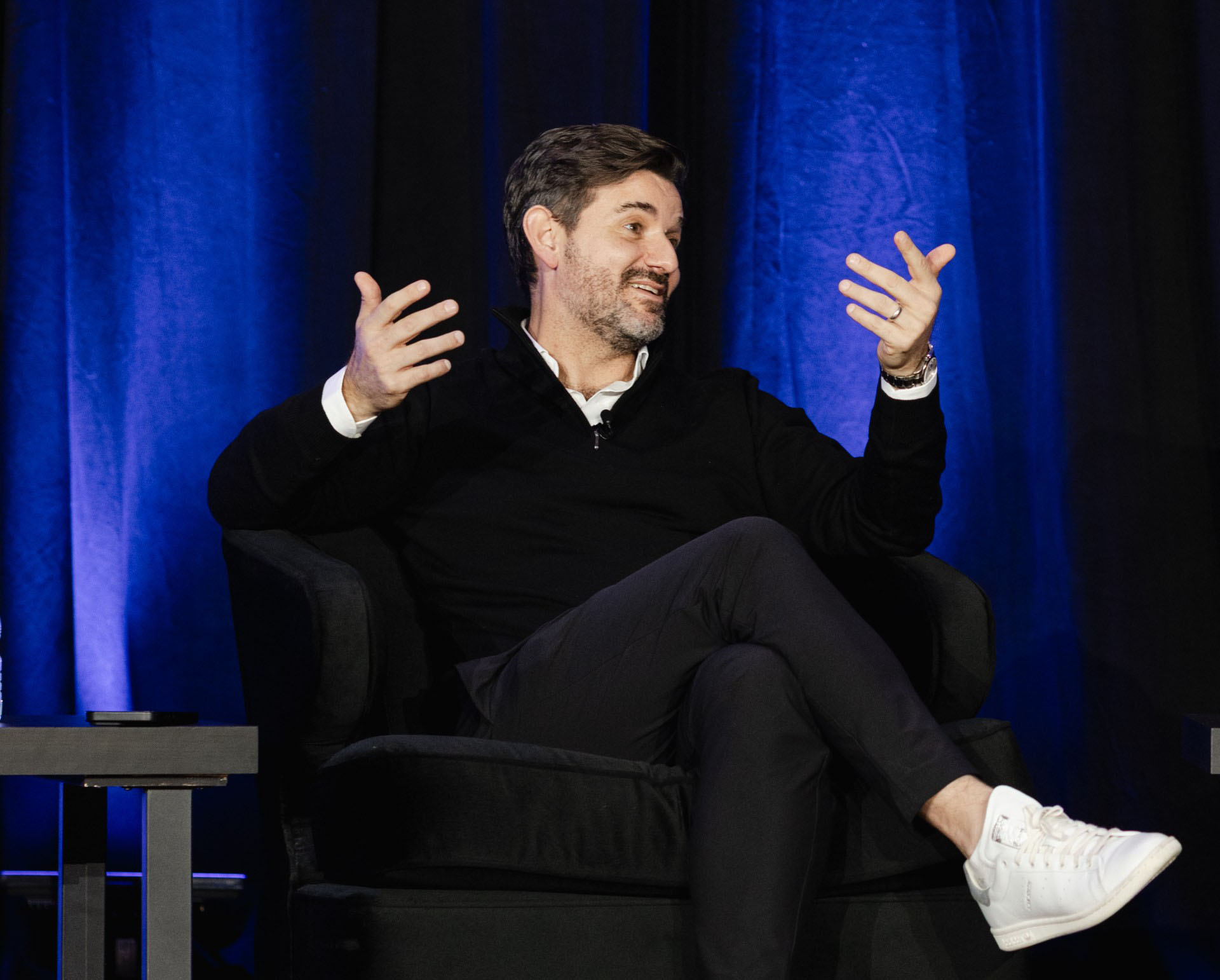
Few who have met Michael Hyatt would ever accuse him of being boring—except perhaps Hyatt himself.
Hyatt is one of Canada’s best-known entrepreneurs and investors, and he has built a media profile as an outspoken and engaging business commentator. But during a Nov. 25 keynote appearance at an event hosted by the Schulich School of Business’s Office of Innovation and Entrepreneurship in Toronto, he told moderator Cherry Rose Tan that he has adopted a perhaps-surprising motto since his family office started up in 2017: “Get boring fast.”
At the Schulich event, which explored the nexus between family offices and venture capital in Canada, Hyatt explained that his family-office investment mindset is far different from the entrepreneurial spark that led him and his brother Richard to found and successfully exit two technology companies (BlueCat and Dyadem). “I’m not trying to get a 36 per cent return every year—I’m looking for probably around eight to 10 per cent, at best,” he told Tan, who is entrepreneur-in-residence at the Schulich Office of Innovation and Entrepreneurship. “And you have to stand back and figure out very quickly whether you’re even qualified to be in a family office. I would say that I’m probably uniquely unqualified—and so I’ve built a team around me and slowed down.”
I think you have to be a ‘rightful owner’ of a company to be able to invest in the company.
Michael Hyatt
The “slowing down” part of Hyatt’s career might be hard to see from the outside. He currently serves as a senior advisor at Northleaf Capital Partners, a Toronto-based global private markets investment firm focused on mid-market opportunities; a weekly commentator for CBC; a founding partner of the Rotman School of Management’s Creative Destruction Lab, and executive chairman of DataStealth, a Mississauga, Ont.-based cybersecurity firm in which he and his brother acquired a majority stake in 2023. He also fields, he says, hundreds of pitches a year from firms looking for capital, and he is active as a mentor and advisor to entrepreneurs across the country. Along with Richard, he is also head of the Hyatt family office, and he co-chairs the Hyatt Family Foundation, which supports healthcare, underprivileged communities and other causes.
Canadian Family Offices sat down with Hyatt after his Schulich appearance and asked him about venture capital, his investment philosophy, the goal and mechanics of his family office, and his family’s approach to giving back while making sure their philanthropy is making a difference.
When you talk about your family office’s investment approach, you say your mindset is to be ‘boring’ and focus on benchmark-like returns. How does early-stage investing fit into that approach? In other words, why invest in a start-up at all?
Because if you don’t have a small portion of your money in start-ups, you’re actually, on a risk-adjusted return basis, losing money. You have to do something there in that area over a 10- or 20-year period. But I think you have to have a panache for it, in the sense that you have to want to do it.
Now, there are plenty of family offices that say, ‘Look, we made our own money in real estate,’ and a bunch of them don’t do tech because they don’t know it. The reason they’re so good at real estate is that they dance with who they brought. They consistently deal with what they know, and they don’t do the startup stuff. I wouldn’t dabble in buying the assets that they have, because I don’t understand them like they do. But I do understand tech. So, I think you have to be a ‘rightful owner’ of a company to be able to invest in the company—that’s No. 1.
And No. 2, if you can do some early-stage investing, you should, because you can get an outsized return, right? So, a very small percentage of your overall portfolio should go into it. And if you look at your total risk-adjusted return, it should be a part of that package. Like, should you own some Bitcoin? Yeah. Should you own a lot of Bitcoin? No. Should you own some gold? Yeah. But you can’t convince me to own, you know, 20 per cent gold or something, right?
You know, I think it’s just an asset allocation. Broadly, you could treat the S&P 500 like a bucket of liquidity and then have some private equity. If the S&P is [returning] eight to 10 per cent, a good private equity company really should [return] about 600 to 800 basis points, on average, above the S&P.
So, a 16 or 17 per cent return?
Yeah. The problem is a lot of people are working to get higher than that. And I think they’re taking too much risk to get into the 20s. But if you take the great private equity firms that are very consistent, that are on fund No. 10, that don’t actually need your money because they’re raising five billion at a time, then you can actually do quite well and protect yourself from yourself—because you could always get scared and sell your S&P, but you can’t do that in private equity.
So, the barbell is S&P, private equity into the teens [in return percentage], and if you want to be into the 20s, 30s and 40s in return profile, the only way I know how to do it is to actually buy a majority of a company and have complete control. Yes, sometimes I can do that on Bitcoin in some years. I can do it on Nvidia in some years. But on average, you have to have operational control of a company to beat private equity over a 10-year period. You have to be the private equity.
I have three young children, and if something happened to my wife and me, I’m sure … plenty of people would come out of the woodwork that would want to advise them…. I don’t trust that.
Let’s talk about your family office. How do you divvy up responsibilities with other family members?
My [older] brother Richard and I are the principals, and then we run it for the broader family. My older brother has eight children, I have three, and my younger brother has three. So, there are a lot of kids. It’s quite a Christmas party. It’s a lot of turkey.
Why did you set up a family office?
We wanted to create an intergenerational platform to protect ourselves from ourselves. What I mean by that is that our job was to preserve our wealth and preserve our capital. And to do that, we need to set up a structure that is done properly from a legal and tax perspective. There’s also sort of like just knowing what the family’s doing—buying things, selling things, and so on.
There’s a whole administration to a family office, and we wanted to create a team around the family that could always advise them. I have three young children, and if something happened to my wife and me, I’m sure there are plenty of people that would come out of the woodwork that would want to advise them and manage their money. And I don’t trust that. I want it to be very long-term people who understand the intricacies of our family and what we’re doing. And I would try to save my family from themselves, because it’s very, very easy when the markets get pumped up like earlier this year to think you’re a genius. It’s very, very hard not to panic when the S&P is 30 per cent off.
But that’s the point. You have to be like a very good card player. You don’t get too excited when you win a hand. You don’t get too excited when you lose one.
How do you and your brother make decisions, since you’re co-principals?
So, when we’re looking at an investment, my brother will technically opine on the company, and I’ll look at it as well. Our CFO will look at it. Our lawyer will look at it. Our chief investment officer will look at it. There are no official votes or anything like that. It’s like, how do we see it? And it’s consensus. But most of the time, we say no to things. If it’s not a real, real strong yes, it’s always a no.

And why is that?
Because the likelihood of any investment being right is lower than you think. Every deck you get as a family office can look good. You just have to figure out where the bodies are buried when you look at it. No one’s going to tell you where the bodies are. That’s the trick to the game, right? I mean, I can’t believe the number of decks I get that are almost guaranteeing me returns, which are just red flags from the get-go. I don’t even open them.
And what do we look for? Things like, well, how much have the principals that are running this fund committed to this thing? Have they really committed their life savings to this thing? How aligned are we with these people? How do they get paid? Show me how they get paid and how much they put into it, and I’ll show you how they behave.
Give me a sense of how many pitches you get. It doesn’t sound like you’re going out of your way to find them.
I’m not going out of my way. I get 10 to 100 LinkedIn requests a day. A lot of people send me an overly intricate seven paragraphs and I just don’t have time to read it. I mean, if you can’t just tell me quickly what you’re asking me, then right there is a flag. And then a lot of people just send me the deck. And that means that they’ve sent that deck out 10,000 times, right?
Let’s switch to your family foundation. Did you set it up at the same time you started the family office?
No, we started the Hyatt Family Foundation in 2011. And we just recently brought it back up over $10 million. We’re giving away approximately $400,000 or $500,000 a year right now because we’re in the markets and it’s just spewing out cash. And if you look in Canada, $10 million is sort of the largest of the small foundations in Canada.
Do you have a separate governance structure for the foundation, or is that sort of administered by the family?
Administered by the family and run by my wife. She’s a very talented lawyer, and she’s worked in the giving space for some time. She took over running it, thank God, because it is very hard to give away money. If you want to give away money and want to understand what your money did, it’s actually way harder than you’d think to hold people to account and hold charities to account.
The rule [for our giving] is: Show me the purchase order that you’re buying it right now and when is it coming.
Can you unpack that a little bit. Why is it so hard?
You’d be surprised how many people can’t actually show accountability for something that they want. So, we get very tactical. I’ll give you an example. We buy a lot of stuff for St. Michael’s [Hospital in Toronto] because our kids were in the NICU [neonatal intensive care unit] there. But the kind of joke with them is that they know what I’m going to say when I’m giving them money. I’m like, ‘What do you need?’ They’ll say, ‘I need an ultrasound.’ And actually, today, we just bought them an ultrasound. So, we just gave them $74,000 today for an ultrasound that they desperately needed.
They know what the rule is. And the rule is: Show me the purchase order that [confirms] you’re buying it right now and when is it coming. So, I force the equipment purchase as part of the donation. Like, show me that this isn’t just going into a pool of money. I would go into the NICU and I would literally ask the nurses, ‘What do you need?’ And they’ll say, ‘We need scales, we can’t weigh the babies properly, we need towel warmers,’ so I would [donate for] stuff that the nurses said they needed. And I would make them buy it. I want to see the purchase orders. If they say to me, ‘The ultrasound’s going to take a year to purchase,’ I wouldn’t purchase it. I’d keep my capital for a year.
So those things are tricky. With food banks, we just sponsored 400 families in a food bank near us. Every Wednesday for a year, 400 families pick up eggs and bread, and we’d go there and see the eggs and bread, and they’d literally show us they go to Costco to buy it.
So, we like to have a very on-the-ground touch. But it’s very easy to get unaccountable for things. There’s a lot of people that approach us that want money for something. And when they send you their marketing, you don’t really know what it’s doing. So, we force a bit of entrepreneurialism, a business case onto everybody that takes our money. We’re looking for a social return. And we also generally make them do a matching fund. [Editor’s note: After this interview, the Hyatt Family Foundation launched a $75,000 matching donation fund to support food and emergency clothing for the homeless at the Common Table in Toronto; to date, total donations have surpassed $200,000.]
[Philanthropy] comes down to accountability, and what does that mean? I’m not looking to put my name on something.
But you know, if you ask me every year what makes me feel good, it’s honestly that we brought the foundation up to $10 million this year. We keep adding to it, making it bigger. It’s a very nice feeling, to know that you’re doing stuff. To be honest, it’s a bit selfish because it gives me purpose. I feel very purposeful. So, I get a bit of a return out of it, if you will.
Again, it comes down to accountability, and what does that mean? I’m not looking to put
my name on something. Our hospitals—we waste a lot of money in this country, and we
should be properly funding hospitals and especially hospital equipment. I mean, a lot of equipment that you see in a hospital comes from donations. For all the bashing people get for doing well in this country, a lot of it comes from people donating a lot of money to build a lot of infrastructure. I think both our provincial and federal governments don’t have the right set of priorities on this yet.
But you know what? I would tell every Canadian one thing that’s simple about this: if you go to the hospital, you’ll be praying very, very quickly that somebody puts something into a machine that’s going to save your life or your family member’s life.
You know, the Peter Munk [Cardiac Centre at Toronto’s University Health Network] saved my father a number of times. And let me tell you, Peter Munk did a lot of good there. That cardiac unit is pretty incredible. I remember calling the Cleveland Clinic [a highly respected medical centre in Ohio] and they said, ‘Oh, you’re at Peter Munk? You’re not going to do much better here.’
What other areas of giving is the foundation focused on?
We support international reproductive and maternal health programs for people in crisis. And we work with a couple of charities that fund medical bills. For example, we have flown a family down to Texas for proton therapy for their kid.
You mentioned you set up the family office to build intergenerational legacy. Have you thought about that from a philanthropic perspective?
My kids are a little young right now. But it’s funny. Next Wednesday, I’m going to bring my six-year-old to hand out stuff at the food bank. And I want to start discussing what that means, what we’re doing and why we’re doing it.
Joe Chidley is Managing Editor of Canadian Family Offices. His 35 years of experience in journalism and communications includes nearly a decade as editor of Canadian Business magazine and as a senior writer and associate publisher at Maclean’s newsmagazine. He served as a columnist at the Financial Post and as editor-in-chief of Content Works, Postmedia’s commercial content division. He also led the corporate and public affairs department at a major Toronto-based public relations firm for several years.
The Canadian Family Offices newsletter comes out on Sundays and Wednesdays. If you are interested in stories about Canadian enterprising families, family offices and the professionals who work with them, but like your content aggregated, you can sign up for our free newsletter here.
Please visit here to see information about our standards of journalistic excellence.