


This article is part of our special report on “Educating the Next Generation of Family Office Leaders.”
Families who want to understand how their own money works have more choice today than their parents and grandparents did, says Anna Stephenson. She’s co-founder and managing director of Inflection Point Intelligence (IPI), a private education company that has recently added a family office-specific program to the existing educational options for enterprising family members and their advisors.
Although IPI was founded in Hong Kong in 2015, it operates internationally. Stephenson is based in London.
“Until a few years ago,” she says, “family offices really relied on their private banks in Europe and England and the [United] States. What we’ve seen as the great wealth transfer has happened is a move towards independent financial advisors and wealth advisors. People have moved more into private equity and alternative assets, and you can use technology to see your portfolio where you couldn’t before.”
There’s nothing quite like this in the rest of the world.
Anna Stephenson
With that increasing complexity and the corresponding professionalization of the family office has come a need for more educational opportunities apart from the in-house training that used to be provided exclusively by the private banks to their own staff.
The subject matter has evolved, as well. Instead of just the investment domain, family offices now embrace legal, financial, taxation and estate-related matters, to name just a few that might in the past have been handled by individual specialists.
“It has changed now to integrated teams, or people doing it themselves in their own family office, and so the context has changed, the ecosystem has changed,” Stephenson says.
IPI had previously collaborated with Henley Business School at the University of Reading (U.K.) on an offering called the Henley Executive Hedge Fund Program, which was designed to introduce people starting a small hedge fund to the necessary aspects of management. Stephenson says that although their students might have had a background as a successful trader or portfolio manager, they were unlikely to be conversant with the details of compliance, taxation and insurance involved with hedge funds.
After the hedge fund program proved successful, the IPI team was looking at the potential for a similar program in the field of private equity. However, Stephenson says, “we were actually lobbied by our clients to do a similar program on family offices, because there’s basically nothing else out there.”
The result was the Henley Family Office Program. Managed and delivered through IPI as the professional partner in the finance industry, with Henley Business School as the academic partner that issues the credential, the program offers a certificate in Family Office Management from the University of Reading.
A different kind of learning
Its clientele is, in Stephenson’s words, “a very different client base than your regular asset manager,” and includes several different segments.
The first and most obvious is the business founder who has perhaps passed through a liquidity event and is looking to understand how to approach the next stage. They might be asking what it could mean to assemble a family office, what staff they would need and what their priorities should be.
We teach practical knowledge; we don’t teach how to invest. We teach how to keep your family organized.
Steve Bernstein
Next would be advisors currently working within family offices who want a broader view of their field, and specialist service providers such as private bankers, technologists and lawyers. Stephenson describes them as either “people who have come up outside the family office world and are having to learn how it’s different from their old work, or people who have come up in one specific function and need now to understand more about their client holistically.”
The final group: next-generation family members, often between the ages of about 18 and 32, who may be moving into roles of responsibility and need an overview of what to expect.
“There’s nothing quite like this in the rest of the world,” Stephenson says.
One of the key differentiators for the Henley Family Office Program is that it is offered by educational specialists rather than by, for example, a legal or financial firm with an interest in deepening its relationship with its client base, explains IPI co-founder Steve Bernstein, who is based in Tokyo.
“We’re educating people about how a family office should be and could be set up, managed and organized,” he says. “Every family office is different—you don’t know what you don’t know. We teach practical knowledge; we don’t teach how to invest. We teach how to keep your family organized.”
With a background in crisis management, Bernstein admits he’s “always thinking about worst-case, always thinking of what could go wrong.” Accordingly, the course is designed to assist families in developing the core principles, processes and procedures that will protect them in eventualities like the passing of a founder.
Flexibility for a global clientele
“We built this program to be jurisdiction-neutral,” says Stephenson. “This is the influence of having a business school behind it: it’s the principles that count.” Since the program opened in 2020-2021, “we’ve had a charity in South Africa, a family office in Australia, and because it’s asynchronous, anyone can take it from anywhere.”
The program consists of 12 modules delivered online at the learner’s pace. They may choose to work through the modules in order or take their own path through the material. A family or a business can enroll as a group, if they wish. It covers a wide range of topics, from the definition of a family office to trusts, philanthropy and the basics of portfolio management. The lecturers are industry experts who are available to be approached individually by the participants.
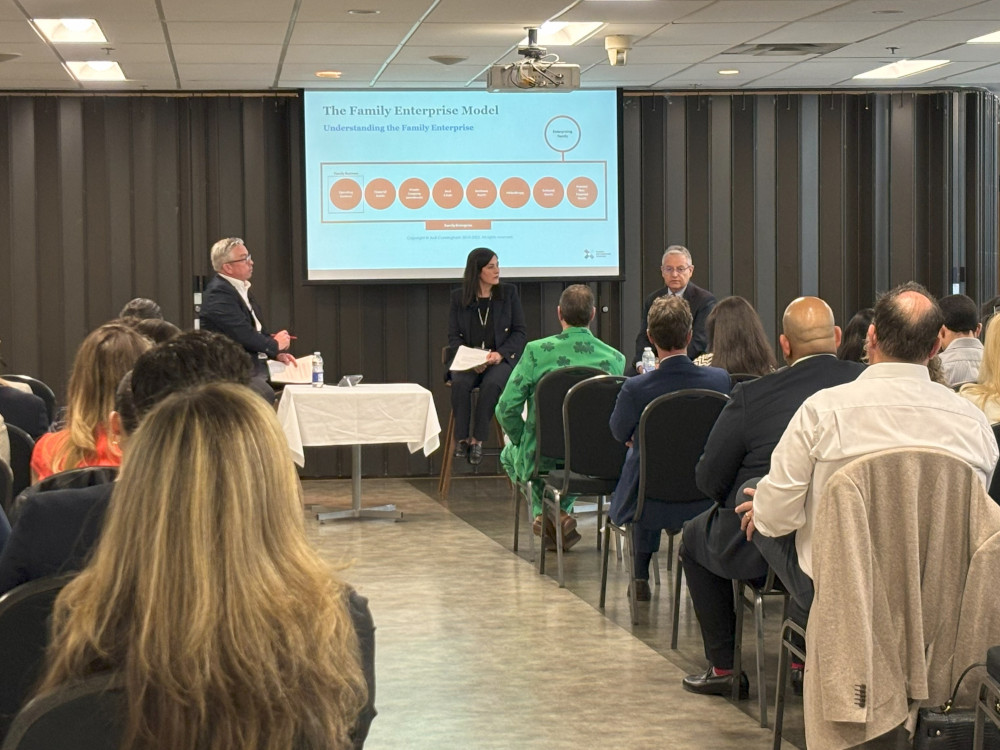


“My favourite is the final module, which is risk management,” Stephenson says. “It sounds like a dry subject, but the risks in a family are not the same as the risks in a bank or in an asset manager.” When a grandchild starts to act out or family members are detained at a border, she asks, “who’s in charge, and what do you do?”
The Henley program fills an educational gap in the field. “The family business, the family and the family office: I see them as three intersecting circles,” Stephenson says. “Old courses in the big business schools used to focus much more on family businesses. I think that we have seen and will see a bit more of a drift from that into the pure family office education space.”
Bernstein believes that AI and other tech tools will be playing a bigger role in family office education in the near future. “In the last generation, you had a trusted advisor. With the advent of technology tools and AI, the younger generation is not afraid to use them,” he says.
“But in order to use those them, you have to understand what the question is. That’s what we teach you: we teach you the process, so you know which question to ask.”
Sarah B. Hood is a Toronto-based writer and book author. She has served as editor of three national magazines and written weekly columns for the National Post. She also serves on the editorial board of Spacing magazine. She writes frequently on business, urban affairs and culture. As a food writer, her work has been translated into Japanese and Arabic. She has taught writing at George Brown College for more than 20 years.
The Canadian Family Offices newsletter comes out on Sundays and Wednesdays. If you are interested in stories about Canadian enterprising families, family offices and the professionals who work with them, you can sign up for our free newsletter here.
Please visit here to see information about our standards of journalistic excellence.