

This article is part of our special report on venture capital and family offices.
FutureSight Ventures is a leading Toronto- and San Francisco-based venture studio. The company co-founds and funds vertical B2B AI-first software companies alongside values-driven entrepreneurs, from ideation, validation and formation to growth, often leveraging the investment and expertise of other family offices.
FutureSight’s portfolio of companies currently includes CrewScope, which assists the construction industry to address chronic labour scarcity; Medivox Health, which uses AI-assisted recordings to enhance healthcare communication and improve patient outcomes in eldercare; Addie, an AI assistant empowering school counsellors with personalized college application guidance; Mercata, which processes and analyzes critical information contained in unstructured investment data for equity managers and hedge funds, and Caring.ai, which offers AI-powered cognitive testing and care.
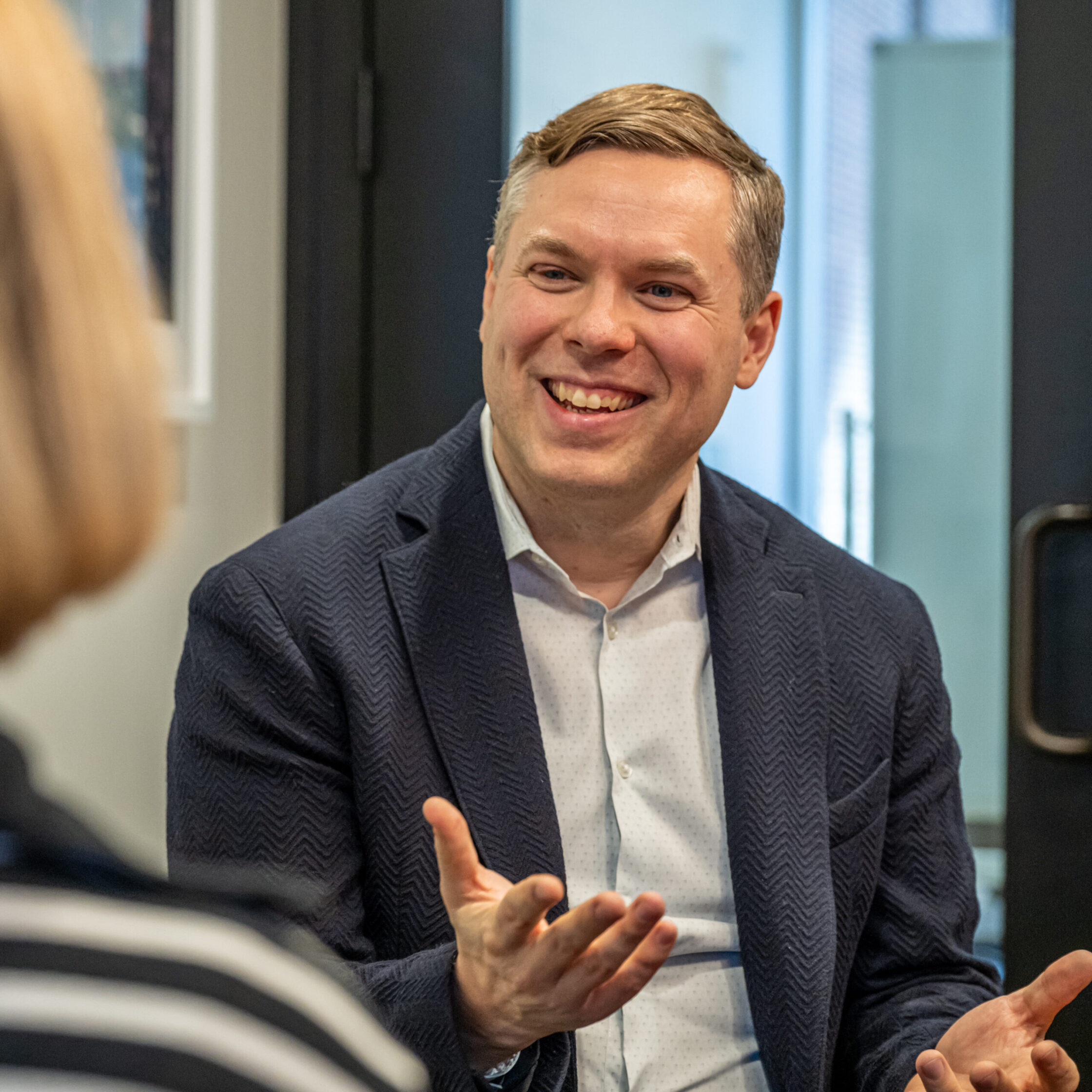
John Carbrey is the founder and managing partner of FutureSight. A passionate entrepreneur, investor and technologist, he has founded, built and sold four B2B software companies and scaled businesses to $100M in revenue. Here, he talks to Canadian Family Offices about his firm’s strategy, the opportunities for family offices in AI and venture capital, and why a revolution in “reasoning abundance” is around the corner.
How would you sum up FutureSight’s strategy?
Today, there are many options in how a family may invest in AI, but given massive capital flows, almost everything is overpriced—especially at the infrastructure layer available in public markets. Our family office is very involved in developing a novel approach in FutureSight and has developed a strategy to build and invest in higher-quality AI-first companies at a material discount to market pricing. We are doing this with a syndicate of other family offices.
Imagine a world where we are never sitting on hold on a phone for anything. Why doesn’t that exist today?
John Carbrey
If families are looking for outsized investment returns, they need to have thematic bets against technology trends. We know this because S&P 500 returns have, over the last few years, essentially been T-bill returns + Technology Alpha. We’re always asking ourselves, ‘What can be done now that could never have been done before?’ Five years ago, there was the cloud, there were all these SaaS tools, but no technology wave that was going to drive a lot of change and advancement in the world. We’re really in this transformative moment with AI and moving from the AI infrastructure build-out to deployment, where we get real-world adoption of AI and create real value.
If you’re a first principles thinker, then you have to ask yourself, ‘How do I invest in AI as a strategy?’
How do family offices answer that question?
There are many different ways to slice it up. There’s the semiconductor layer, the AI infrastructure and cloud providers, such as AWS, Google and Microsoft, with their data centre infrastructure. Then there are the model providers, such as OpenAI and Anthropic, and on top of that, you have the application layer—B2B and B2C. As a family office, you have to figure out how you want to invest. Does a family do it in the public markets? Does a family invest in the private markets? And you slowly work through that determination. What layer of the stack is well-priced or underpriced? Where are things going?
For some family offices, AI is an esoteric topic—one that’s difficult to understand.
Yes, for many Canadian families, especially real estate-focused ones, there’s a lot of fear around AI, which is more of an ephemeral, intangible asset. Also, we have recently seen the ‘SaaS apocalypse,’ where the market is repricing legacy software companies. That may be confusing because some thought they were supposed to be the beneficiaries of AI. In the private debt space, we’ve also seen panic with many people afraid of legacy SaaS software investments or data centre accounting shenanigans. But when you look at real growth over the last 20 to 30 years, it’s really from technology. Few asset classes will be unaffected by AI. After 20-plus years of private equity arbitrage, there is much less future alpha than in the past. Labour markets will be impacted, and it will reconfigure the way we work. Not having an AI thesis for a family office is negligence.
If you have real family office expertise in-house around technology, then I would really lean into that unique ability, using your discernment.
What unites the AI-driven companies in FutureSight’s portfolio?
In North America today, we essentially have a workforce capacity of 100 million white-collar workers. We see that effective workforce capacity increasing by three times over the next five years, through AI capabilities, AI-augmented capabilities and ‘AI employees.’ Our portfolio companies are essentially creating AI employees to augment and massively scale the capacity of the existing human workforce.
For example, Caring.ai is focused on dementia detection. Only 17 per cent of people who need dementia screening are actually getting it. We just don’t have enough doctor time. So we’ve built an AI employee that, before an elderly patient goes to the doctor, will call them at home and have a half-hour conversation with them to complete a dementia assessment. The doctor can then make the ultimate judgment about what to do next.
With Addie, we do college admissions consulting. Used at a high school in Seattle, the guidance staff went off on school holidays. When they came back two weeks later, Addie had completed 600 hours of conversations with students—that is 2.5 months of work that was done for them.



We are entering a world of ‘reasoning abundance.’ Imagine a world where we are never sitting on hold on a phone for anything. Why doesn’t that exist today? It’s because there isn’t enough reasoning capacity available in the labour market at the right price. If we can triple our workforce capacity, the world is going to be such an amazing place as we quickly remove these reasoning scarcity gaps. That is what we are focused on. We are finding opportunities where we can build new AI employees that can make a big difference.
How does FutureSight choose the companies to financially support as part of its portfolio?
We have 8,000 founders applying to work with us per month, and we pick four that we’ll work with on specific AI employee opportunities. At any given time, we’re working on 15 or 20 venture opportunities. We build our confidence on these opportunities through an internal proprietary process. Then we work through seven stages, where we fractionally invest as we grow the company before making our full investment. We’re not coming in as investors in a traditional sense. We’re coming in as co-founders with capital. That gives us a huge advantage in terms of our entry price, because we are rolling up our sleeves to build.
If you had to provide advice to someone deploying VC into a startup that promises to create AI employees, what would it be?
I’d ask myself whether the company’s AI employee could do the majority of a job that humans are doing today—i.e., could it apply on LinkedIn for that job—not one per cent of the job, but the majority of the job. And can it do it 10 times faster?
Peter Kenter is a Toronto-based writer with a deep and abiding interest in how everything in the world works and how it got that way. He’s written about the economy, investing, financial services, cryptocurrency, pharmaceuticals, mining, energy, cannabis, agriculture, consumer electronics, education, sponsorship marketing, and entertainment. He’s the author of TV North: Everything You Wanted to Know About Canadian Television.
Stay ahead of market shifts in alternative assets. Our quarterly Alternative Investments newsletter delivers exclusive analysis, emerging trends and expert strategies on private equity, real estate, hedge funds and more—all curated for Canada’s leading investors and family offices. Subscribe now.
Please visit here to see information about our standards of journalistic excellence.