

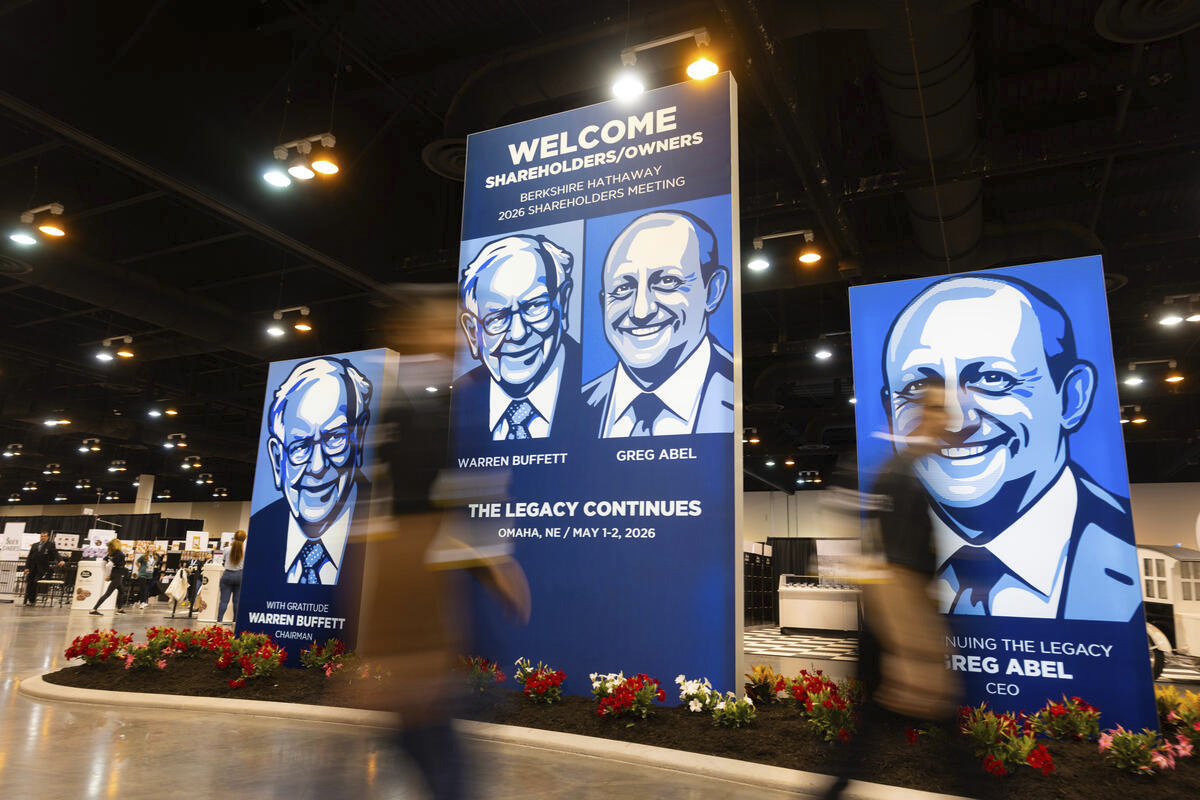
On Saturday, May 2, 2026, the “Woodstock for Capitalists” entered uncharted territory. For the first time in 60 years, Warren Buffett did not take the stage at the Berkshire Hathaway annual meeting. Instead, the 95-year-old chairman sat with fellow board members on the arena floor of the CHI Health Centre Omaha while Greg Abel, who assumed the CEO role at the start of 2026, led the meeting from centre stage. Canadian-born Abel (a nephew of NHL legend Sid Abel, by the way) opened by retiring two jerseys to the rafters for Buffett and the late Charlie Munger, a symbolic gesture that served as both farewell and continuity.
Watching from home this year, I found myself reflecting on the lessons that family offices can draw from Berkshire’s enduring success and on my own experience attending the annual meeting in Omaha in 2018. That year, more than 42,000 investors from a wide range of ages, backgrounds and countries gathered to hear Buffett, then 87, and Munger, 94, answer questions for more than six hours. Beyond a few memorable one-liners from Munger, what stood out was the absence of jargon and theatrics and the consistent reliance on first principles expressed in plain English.
Nearly a decade later, seeing Abel lead the 2026 meeting, I was struck less by how much had changed than by how much had endured. The personalities may have shifted, but the underlying philosophy remains intact. Tested across six decades, multiple market cycles and a major leadership transition, Berkshire Hathaway still offers timely lessons for Canadian family offices charged with stewarding capital across generations.
Institutionalize culture before succession demands it
Perhaps the lesson most directly relevant to family offices is succession. At its core, the 2026 annual meeting was a test of Berkshire’s institutional resilience. No one can replace Buffett, but the more important question is whether the culture and values can endure beyond the founder. Although the transition is still in its early stages, the signs so far are encouraging.
Abel’s first shareholder letter, released at the end of February, struck a tone that was direct, respectful and philosophically aligned with Berkshire’s history. He wrote: “Your capital is commingled with ours, but it does not belong to us. Our role is stewardship. That stewardship has shaped a culture and reinforced a set of values that are not the result of our success, but the reason for it.”
In a separate letter to employees, Abel also pledged that Berkshire’s culture and values would remain unchanged. He emphasized the preservation of the company’s decentralized structure, limited bureaucracy, and focus on long-term competitiveness rather than short-term results.
Berkshire has gradually evolved from personality-driven leadership to institutionalized discipline. Family offices face a similar challenge when transitioning from a wealth creator to future generations. Long-term success cannot depend indefinitely on a single individual, however exceptional. Preserving and compounding wealth across generations ultimately requires clear governance, robust processes, professional resources and a culture anchored in family values.
Prioritize temperament over activity
If there is a unifying thread in Berkshire’s history, it is temperament. Berkshire Hathaway’s market value fell by more than half twice: once in 1974 and again during the 2008 financial crisis. Many family offices should ask themselves how they would respond if a $700 million net worth fell to less than $350 million, and then, decades later, and likely under different leadership, the same thing happened again.
In 2018, Berkshire faced criticism for holding roughly $110 billion in cash. By the end of 2025, Berkshire Hathaway reported about $373.1 billion in cash and Treasury bills, and by the 2026 annual meeting commentators were describing the cash pile as nearing $400 billion. Rather than forcing capital into unattractive opportunities, Berkshire has chosen patience over participation. As Buffett put it in his 2026 interview, the firm can “pick our spots,” and when the environment is not attractive, “sometimes we’re doing nothing.”
Ajit Jain, Berkshire’s vice-chairman of insurance operations, reinforced the point at the meeting, noting that insurance, like investing, requires patience and that it is difficult to persuade people to sit still and do nothing. Abel made a similar point, emphasizing Berkshire’s patience and discipline in capital allocation and its unwillingness to deploy capital into subpar opportunities.
For family offices whose capital base is already sufficient to support the current generation’s lifestyle and long-term objectives, liquidity should not automatically be viewed as a drag on returns. Properly understood, cash provides strategic optionality. It is dry powder that can be deployed during periods of market dislocation, when valuations reset and forced sellers create opportunity.
Protect the conditions that allow compounding
Berkshire Hathaway’s record is often cited but less often fully appreciated. Since 1965, the company has compounded per-share market value at roughly 20 per cent annually, compared with 10.5 per cent for the S&P 500 through 2025. Put differently, $10,000 invested at the beginning of 1965 would have grown to approximately $600 million by the end of 2025, versus about $4.4 million in the S&P 500.
That compounding was not driven by constant activity or tactical brilliance. It was the cumulative result of clear decision-making, conviction when opportunities appeared, reinvestment of earnings, cost discipline and, above all, the avoidance of catastrophic errors.
This is where the alignment between Berkshire and family offices is especially strong. Unlike pension plans constrained by actuarial liabilities, or mutual funds judged on quarterly performance, family offices are structurally positioned to think in decades. The real challenge is not having a long time horizon; it is preserving the discipline required to let compounding work uninterrupted.
Keep costs from undermining returns
Turning to one of the biggest obstacles to compounding—investment costs—I was reminded of a note from Berkshire’s 2018 meeting: Buffett’s now-famous wager against a fund-of-funds manager. In 2007, he bet that a simple, low-cost S&P 500 index fund would outperform a handpicked basket of sophisticated hedge fund strategies over 10 years. He won the bet in 2017, with the proceeds going to Girls Inc. of Omaha. The decisive factor was not a lack of intelligence or effort on the part of the hedge fund managers, but the corrosive effect of fees.
The lesson was not that all active management is flawed. Rather, it was that costs matter and that fees steadily erode returns over long periods. For family offices managing substantial pools of capital, the temptation toward complexity, layered fee structures and performance-fee arrangements is ever-present. Simplicity, combined with cost discipline, can be extraordinarily powerful.
This does not require rejecting all alternatives or all active management. Some hedge fund strategies may still serve a useful role as diversifiers or portfolio stabilizers. But in efficiently priced public equity markets, low-cost exchange-traded funds often remain the more sensible default.
Stay within your circle of competence
In 2018, Buffett was notably candid about his limitations. Despite recognizing the quality of companies such as Amazon and Google, he did not initially invest because he believed their outcomes depended too heavily on factors outside his deepest understanding. Berkshire’s long-standing skepticism toward cryptocurrencies and gold reflects the same framework: assets without intrinsic productive value, driven primarily by sentiment or scarcity, sit outside its preferred universe.
That intellectual humility, the willingness to say “I don’t know,” is an underappreciated element of Berkshire’s success. In his 2026 interview, Buffett reiterated the principle by invoking the idea that he is “smart in spots” and stays around those spots.
For family offices, this principle is both liberating and protective. In a world of constant solicitation and an expanding menu of traditional and non-traditional strategies, it grants permission to decline the latest trend, the most persuasive pitch or the most fashionable narrative when the investment lies outside genuine understanding. If a family office chooses to venture beyond that circle, position sizing becomes critical.
Five core principles
The principles associated with Buffett and Munger remain as relevant today as they were decades ago. For those entrusted with preserving and growing capital across generations, the enduring advantage lies less in complexity than in culture, patience, discipline and sound judgment.
- Institutionalize the family office before succession makes it urgent.
- Maintain liquidity so capital can be deployed decisively when markets dislocate.
- Use the family office’s long time horizon as a structural advantage.
- Guard returns by managing costs with discipline.
- Stay within your circle of competence, and size any exceptions carefully.
Trevor Hunt is head of client engagement and portfolio manager for Our Family Office Inc., based in Toronto.
The Canadian Family Offices newsletter comes out on Sundays and Wednesdays. If you are interested in stories about Canadian enterprising families, family offices and the professionals who work with them, sign up for our free newsletter here.
Please visit here to see information about our standards of journalistic excellence.