

This article is part of our Special Report on “Educating the Next Generation of Family Office Leaders.”
What’s the difference between the educational needs of members of a family enterprise and members of a family office? The Family Business Institute (FBI) at the Ted Rogers School of Management at Toronto Metropolitan University (TMU) stresses that those needs are fundamentally similar.
“At the outset, the foundational topics are much the same,” says Janie Goldstein, co-launcher of the FBI and a lecturer at the Rogers School. “The critical concepts and best practices around governance, succession planning, financial literacy, and family dynamics are critical to both segments.”
The FBI’s mission in delivering what both segments need rests on three pillars: education, research and engagement.
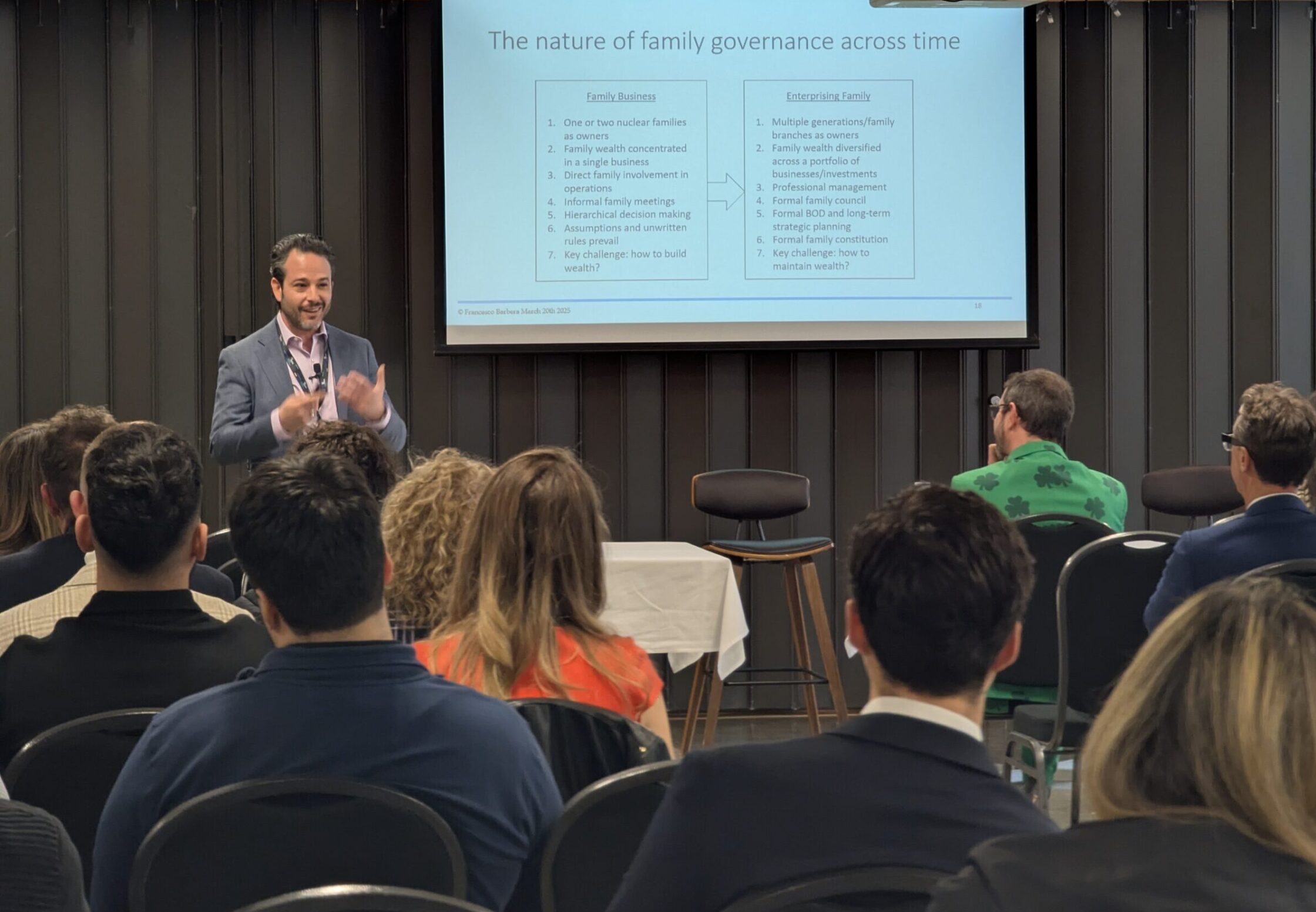
“We’re very interested in the overlap that’s happening between those spaces,” says Francesco Barbera, founding academic director of the FBI and an associate professor of entrepreneurship and strategy at the Rogers School. “We want to encourage the synergies that happen in the middle.”
FBI course offerings
The FBI currently offers two undergraduate courses aimed at family office and family enterprise education.
Family Business in Canada
The course focuses on planning, succession and control, and studies many of Canada’s internationally known family-run businesses. Students learn about the challenges faced by the owners in planning and succession, as well as the impact that family structure plays in determining the future of the firm. Students are often part of a business family, but it isn’t a prerequisite. The final group project, known as “Pulse of the GTA Family Business,” requires students to interview 15 to 20 family business leaders and analyze the findings as a group.
“Through this project, students not only learn valuable transferable skills, such as communication and analysis, but also see how the course concepts play out in real life,” Goldstein says.
A related speaker series highlights presentations from experienced family business members and family office leaders, including Mo Lidsky, chairman and chief executive officer of multi-family office Prime Quadrant; Henry Shew, head of tax at Our Family Office; and Richa Bahl, currently a partner at PwC in Toronto, where she leads the family enterprise advisory practice across Canada.
“For many students, the family office space is a mysterious world,” Barbera says, “and these speakers answer a lot of the questions about what a family office does, how they can get involved and what sorts of activities occur there every day.”
Case Studies in Family Business
This course is organized around family enterprise case studies and provides a training tool for students aiming to be professional advisors or leaders of family enterprises. Barbera created the course to address a need to develop the skills to analyze complex business situations, including family dynamics and the very human aspects of family business. Students who represent TMU in the Schlesinger Global Family Enterprise Case Competition are chosen from this course.


Engagement through events and extracurriculars
The FBI also organizes a number of events and extracurricular opportunities, including:
- A family business club, launched by students.
- In-person events, including an appearance by the Singh family, stars of the CBC business reality TV show Bollywed, and recent speaker panels hosted on campus with partner Family Enterprise Canada, a national community and resource hub for Canadian family businesses.
- Participation in the Schlesinger Global Family Enterprise Case Competition. TMU students have reached the podium in the first two competitions in which they’ve participated.
- Free webinars.
FBI research
“I think one of TMU’s strengths is that we have polytechnic beginnings,” Barbera says. “We’re more of a grassroots, in-the-streets kind of university. We’re doing very practical research. And we’re also taking some of that scholarly work and translating it down to different audiences and sharing it with those who will get the most value from it, including family businesses and family office stakeholders.”
Among the institute’s current research projects:
- “The Pulse of the GTA Family Business” study, which leverages the data collected from almost 800 responses as part of the Family Business in Canada course, to seek greater insights into family business. “Many of the interviewees are from smaller businesses, but the findings are telling,” Barbera says. “For example, preliminary findings indicate that 80 per cent of family firms wish to keep the business in the family, but only 29 per cent have established a family succession plan. We aim to make our research findings very accessible and will continue to delve much deeper into the data.”
- The “next-gen development project,” derived from a student research pool of more than 900 survey responses, many from potential next-gens. The project outlines their views on being part of a family business, their career progression (within and/or outside the family firm), perspectives on education requirements, family relationships, sense of self and key challenges. “Young people growing up in a family business system face a lot of challenges to becoming their own person, because often these family business systems are very enmeshed and they have a hard time identifying who they are as individuals outside of that family system,” Barbera says. “This project is helping to identify these challenges and how they can be overcome, in part through education.”
- The “pedagogy study,” which examines the benefits of the experiential learning approach of the Family Business in Canada course and how skills can be transferred to various career paths.
- The “identity study,” conducted in affiliation with KPMG Family Office, which looks at the way in which incumbents and next-gens identify with the family enterprise, and aims to generate important considerations for advisors who seek to be more effective with succession planning.
FBI offerings continue to evolve
The FBI sees an expansion of family enterprise training, supported by research and engagement, as essential to the growth of family offices in Canada. For example, the institute is in discussion to develop executive education programs customized to specific organizations. Family offices, for example, could work with the FBI to provide custom training for business family members or their family office teams.
“In offering those opportunities, we’re developing the next generation to be future leaders and, one day, to take that legacy family business to the next level,” Barbera says.
Peter Kenter is a Toronto-based writer with a deep and abiding interest in how everything in the world works and how it got that way. He’s written about the economy, investing, financial services, cryptocurrency, pharmaceuticals, mining, energy, cannabis, agriculture, consumer electronics, education, sponsorship marketing, and entertainment. He’s the author of TV North: Everything You Wanted to Know About Canadian Television.
The Canadian Family Offices newsletter comes out on Sundays and Wednesdays. If you are interested in stories about Canadian enterprising families, family offices and the professionals who work with them, sign up for our free newsletter here.
Please visit here to see information about our standards of journalistic excellence.