

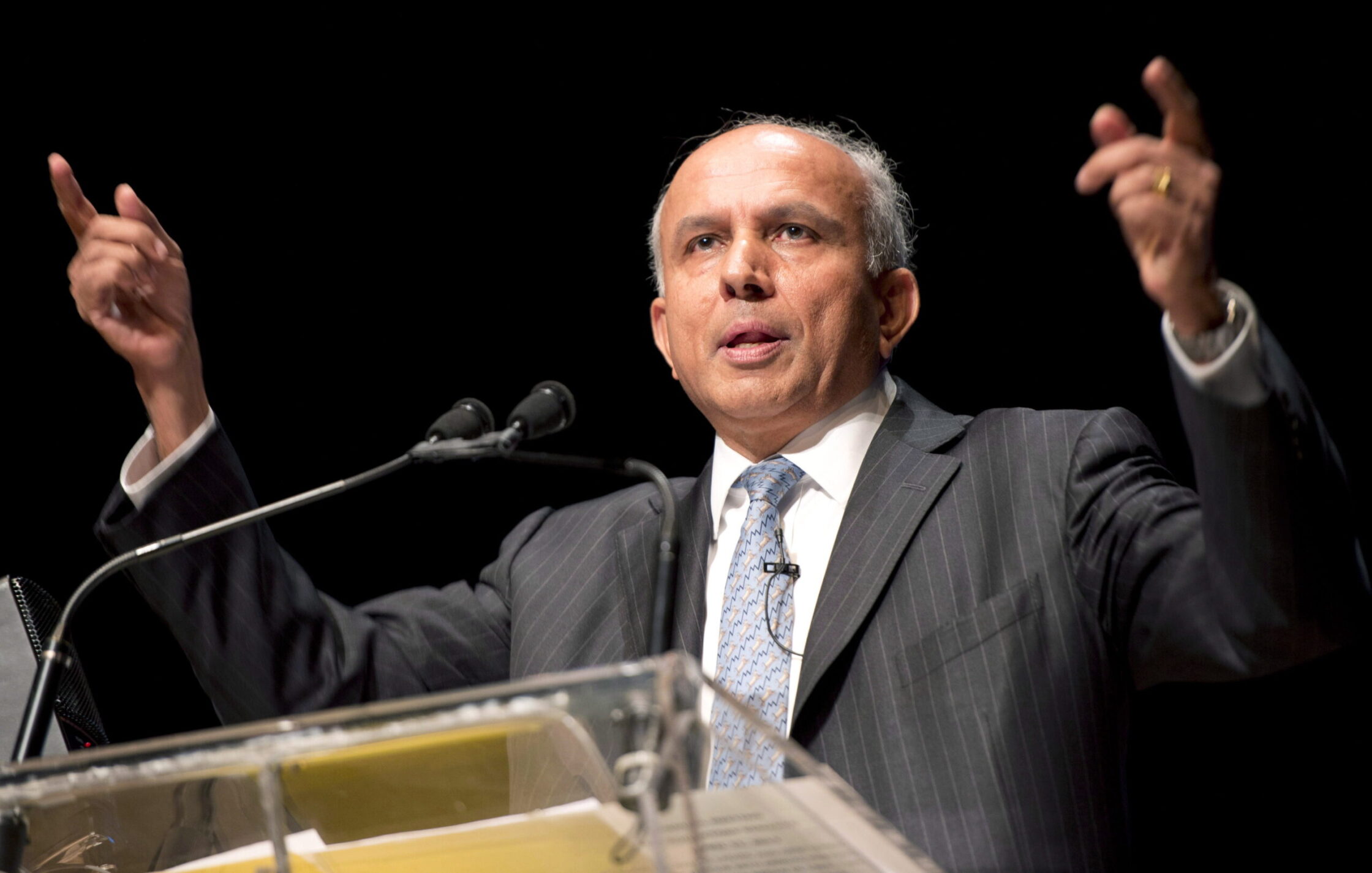
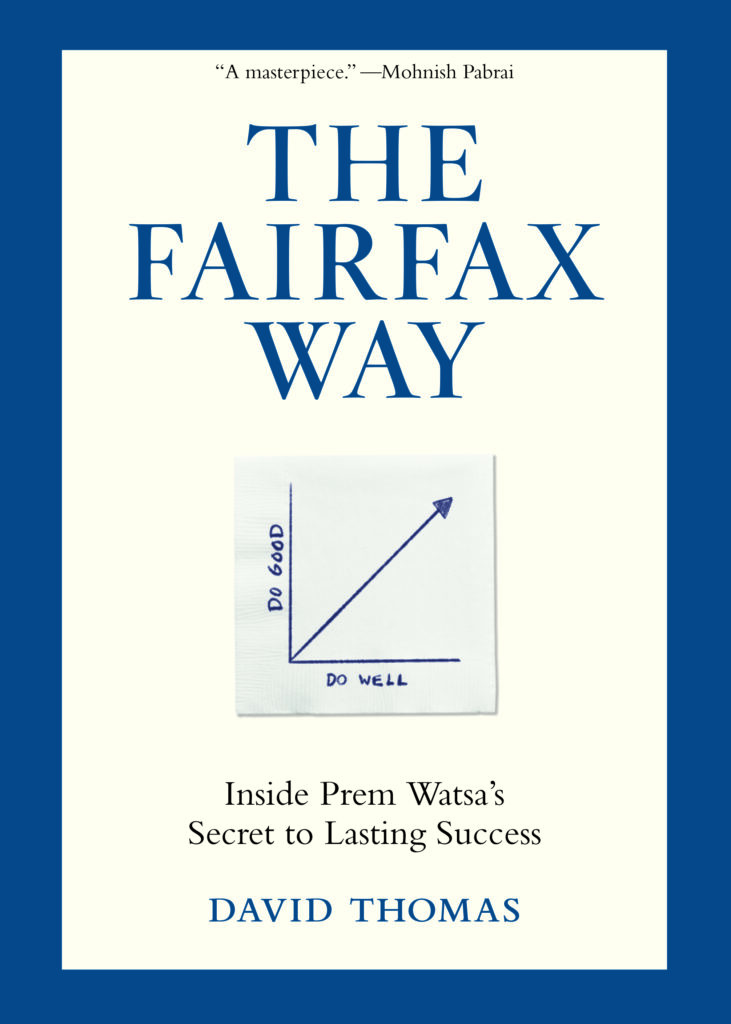
Throughout his remarkable career, Prem Watsa, founder, chairman and CEO of Fairfax Financial Holdings, has assiduously avoided the media spotlight. But in David Thomas’s recently published book, The Fairfax Way: Inside Prem Watsa’s Secret to Lasting Success, Watsa shares—in a way he never has before—his experiences, insights and the philosophies that drove Fairfax to become a global powerhouse. And there is a lot to share. Here, in the first of two articles, Thomas highlights Watsa’s thinking on “compassionate capitalism” and the right way to give back, as well as the importance of people and patience to his investing style.
Business with compassion
Prem Watsa says capitalism can often get a bad name. The founder, chairman and CEO of Fairfax Financial Holdings sees it differently, insisting free enterprise is the best single force for the betterment of society—if you get it right.
“Very simply, we truly think of business as a good thing,” he explains. “We think capitalism is great, but it can be even better with compassion.”
In compassionate capitalism, he reasons, we all have a responsibility to give back. Why? “Because if you think you did it all by yourself, you didn’t. I see our opportunities and advantages as blessings, and you have to give back.”
Fairfax’s founder is hardwired on principles. Even when he was penniless growing up in India, and had no inkling of becoming an investor or building a global empire, he had an impulse that you should take care of your family and community. What captured his imagination on the capitalism context was reading a little book someone told him about on a train as a young man. He has never stopped thinking about it. The book was Napoleon Hill’s Think and Grow Rich, which carried the message that capitalism was the ideal engine for a successful society and the riches it generated should be used to raise all boats.
Fairfax translated that notion into a corporate concept of “Doing good by doing well,” which emphasizes the need to make money in order to be able to share it. As the company celebrates its 40th anniversary, it can also celebrate how growth in earnings has translated into growth in philanthropic giving, reaching a compounded annual rate of 20 per cent.
If you think you did it all yourself, you didn’t.
Prem Watsa
Fairfax started with a target of sharing one per cent of pre-tax income and later raised that to two per cent. Including a top-up, that formula led to US$95 million in giving by the company in 2024. Total giving to date is in the range of half a billion dollars.
“We are a small microcosm of what business does worldwide,” Watsa says. Over and above the two per cent rate, the company matches employees’ individual giving. Personally, Watsa finds other ways to give back. He has sat as chancellor at two universities, managed money for SickKids, donated $10 million for a Fairfax Centre for Free Enterprise at Huron University, and chairs the Canadian chapter of the Horatio Alger Association, which provides scholarships to students who need help pulling themselves up.
Some of the management strategies that have made Fairfax successful are also at work in how the company gives money away. One is the magic of compounding, which can be found in how Horatio Alger support can be a gift that compounds or keeps giving.
“It means they will be in the position to achieve business success and be able to lift others as well, as a compounding effect of giving back,” Watsa says. “Some of us, whether by birth or parenting or geography, don’t get the opportunity. And all of us who are doing well should have compassion for them.”
The concept of decentralization, central to how Fairfax operates as a small holding company with local autonomy, is always part of the strategy. Its almost 30 operating companies direct half their giving into jointly managed foundations for higher impact, but spend the other half directly in the communities where they operate. Fairfax operates in more than 100 countries, so that approach ends up reflecting the priorities of local employees, customers and residents.
Investing and acquisitions: How much are people worth?
For all the formulas and ratios in value investing, good luck finding one that measures the value of employees or culture or retention. But there are clear signs when a company is getting it right. One is some kind of high engagement score based on employee surveys. Even better is how long employees, especially top talent and leadership, stay with the company. And if a company like Fairfax is outperforming while measuring retention in decades rather than years, it is safe to conclude that your culture is driving performance, says Watsa.
From the outset, Fairfax knew that the first decade or two of its existence would be big on acquisitions, with an emphasis on organic growth to follow once it had the core heft. What the company refused to do was to buy companies and gut them for synergies.
Business tends to be considered a jungle and a war zone. And many people do not treat people well, but just treat them as bodies.
They made it a core principle to operate in a “fair and friendly” way. That might sound a little corny to rapacious M&A lawyers and bankers, whose first thought in planning deals is often to see headcount as a line item that can yield synergies and cost cuts.
Fairfax planted a flag on values: they would never get into competing bids, never back out of a deal or seek revised terms. They also said they would only consider layoffs in extreme circumstances. That’s the “fair and friendly” part, and it ended up guiding them in choosing their company’s name. (It’s a portmanteau of “fair’,” “friendly” and “ax,” for acquisitions: Fair-f-ax.) Again, it might sound corny but, in addition to being a case of doing the right thing, they believed that operating under a strong culture as a “good company” would drive performance and have a major impact on growth and the bottom line.
“We have found it odd, but business tends to be considered a jungle and a war zone. And many people do not treat people well but just treat them as bodies,” Watsa once said in a speech. “This just happens to be the way we want to live, but the advantage in a business sense over time is that inside your company, you see ordinary people do extraordinary things. And outside your company, people trust you.”
Fairfax believes that treating people well could create intrinsic value to help the company outperform. And the culture that resulted could act as a competitive moat. So, it is both the nicer way to run a company and a smarter way to outperform. It hasn’t always been an easy strategy to follow, but Fairfax has always preferred to buy only companies that had great management.
As value investors, that meant due diligence had to go well beyond valuation metrics. Watsa admits he was more driven by finding cheap prices in his early days, but he adapted his value playbook to be as much about management and human skills as metrics.
“As a disciple of [Ben] Graham, I was more value-oriented before—more mechanical or formula-based in terms of book value,” he says. “But I evolved to really value management above all in investing in companies.”
In recent years, Watsa has taken to repeating a quote that sums up his thinking and shows his debt to Phil Carret, a legendary value investor who pushed investors to dramatically boost management quality as a factor in investment decisions. These are words Fairfax lives by: “Good management is rare at best, it is difficult to appraise, and it is undoubtedly the single most important factor in security analysis.”
Patience and long-term thinking
Long-term thinking has always been central to how Fairfax Financial operates. Its founder was shaped by the key discipline of patience practised by value practitioners. It’s in his DNA. Patience drives decision-making on financial performance and management strategy.
Sometimes, it can also drive shareholders nuts, as when the company remains patient too long with certain investments (hello, BlackBerry) or strategies (like the cautious but expensive hedging protection purchased between 2010 and 2016).
We expect to make money over time, not in the next month or two.
Anyone who invests in the company soon learns that management is not at all interested in quarter-to-quarter results and likes to keep its eyes trained well off in the distance. Fairfax was born with the recapitalization of the broken Canadian trucking insurance assets of Markel, a U.S. firm, in 1985. With his first letter to shareholders, Watsa laid out the philosophy:
“We expect to make money over time, not in the next month or two,” he wrote. Followers of Ben Graham, the father of value investing, would recognize the next bit: “In our purchases, we are always trying to first protect your capital from long-term losses before attempting to make money.”
Later, in 1999, Watsa appealed to shareholders who were freaked out when the company’s stock faltered after an unsustainable acquisition binge. He wanted them to think past the drawdown and focus on how the company was focused on building earnings power for the future, not on selloffs in its own overheated shares. Investors, unfortunately, are typically not so focused on the long term when the short term is bleeding red.
Fairfax, Watsa insisted, would always accept short-term volatility in earnings or share price for the benefit of long-term results, calling that “the single most important statement about understanding the Fairfax philosophy.”
As value guys, it’s simple: You expect to get outperformance by finding quality stocks on sale and waiting as long as it takes for the market to wake up and price them right. And patience doesn’t stop there: the only way to put the magic of compounding to work is to hold for the long term.
Fairfax’s most successful investment, Eurobank in Greece, is a testament to patient value. The company got in when a global debt scare in the aftermath of the Global Financial Crisis threatened to sink several European economies. A few painful recapitalizations nearly wiped out the investment, but Fairfax stood by and invested more. Today, Eurobank is the largest non-insurer operating company holding at Fairfax and a major contributor to earnings.
David Thomas is the author of The Fairfax Way: Inside Prem Watsa’s Secret to Lasting Success, published by Viking, a division of Penguin Random House Canada. All quotes are reproduced from the book.
The Canadian Family Offices newsletter comes out on Sundays and Wednesdays. If you are interested in stories about Canadian enterprising families, family offices and the professionals who work with them, but like your content aggregated, you can sign up for our free newsletter here.
Please visit here to see information about our standards of journalistic excellence.