

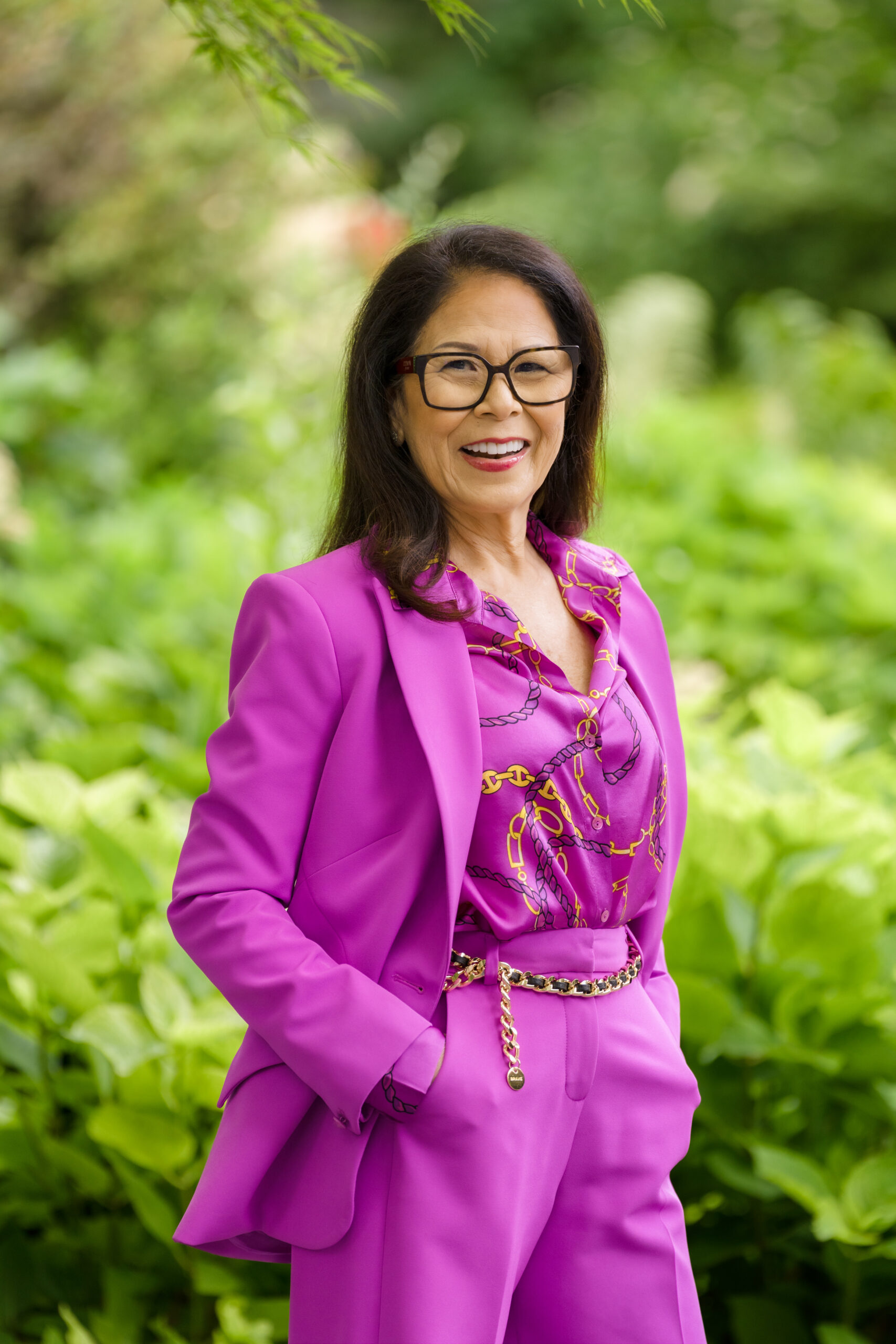
Dr. Donette Chin-Loy Chang is a champion of education and leadership. Over several decades, she has supported Canada’s education system through generous funding of scholarships and well-being initiatives at Toronto Metropolitan University (formerly Ryerson University). She has been a driving force behind TMU’s DMZ, a tech incubator and startup ecosystem; the G. Raymond Chang School of Continuing Education, named after her late husband; the Lincoln Alexander School of Law, and the newly named Nadir Mohamed Centre for Student Wellbeing at TMU, which broke ground in May. In 2024, Chin-Loy Chang was appointed the sixth chancellor of the university, a position in which she serves as TMU’s ambassador at the local, national and international levels.
Those achievements follow a 40-year career as an award-winning communications leader and decades of philanthropic efforts alongside her husband, who also served as TMU’s third chancellor. Together, they established a legacy of generosity to causes in education, healthcare, social justice and the arts, both here at home and globally.
Born in Kingston, Jamaica, and a 1978 graduate of TMU, Chin-Loy Chang worked in the overseas service of Radio Canada International, as a reporter-producer with CBC Radio in Toronto, has written for a number of publications and has trained journalists throughout the Caribbean. She was a strategist for global public relations firm Ruder Finn & Rotman, providing counsel to the Prime Minister of Jamaica, ministers of government, heads of Crown corporations and media practitioners. Later, she was made head of radio at the Jamaica Information Service, and she went on to found Donette Chin-Loy and Associates, a leading communications firm in the Caribbean, and co-founded La Grassa Chin-Loy Communications in Canada.
I have always been curious about everything around and beyond, so it seemed natural to choose journalism.
Dr. Donette Chin-Loy Chang
Since her husband’s passing in 2014, Chin-Loy Chang has continued her philanthropic work, notably as co-chair of Food for the Poor Canada, an international relief agency. She is also co-patron of the University of the West Indies annual benefit awards, a significant fundraiser in support of student scholarships. In the areas of racial equality and human rights, she served on the dean’s advisory board for TMU’s Faculty of Community Services and was a member of the university’s renaming committee. Currently, she is a board director for the BlackNorth Initiative and the Toronto International Film Festival, and chairs TMU’s Alumni Council. She also sits on the advisory boards of the Onyx Initiative and TMU’s Anti-Asian Racism Taskforce.
Here, she shares how her hardworking parents were champions of her education and career choices from her youth in Jamaica to high school and beyond in Canada.
What are your fondest memories of growing up in Jamaica before your parents moved to Canada?
My fondest memories are being surrounded with lots of family, of childhood friends, schools that encouraged my growth, and a joyful upbringing.
What do you remember about your first years in Toronto at the end of high school?
I completed Grade 13 in Toronto—Thornlea Secondary. It was in a cold September that I arrived in Toronto with my mother. We stayed with cousins. It took me a while to understand and appreciate various cultural norms and attitudes. I adapted quickly. It was the cold weather that was the most difficult to get used to and the different cultural backgrounds of my new friends in Canada.
When did you become interested in writing, business and entrepreneurship, and who were your earliest mentors?
Some people express themselves through music or painting. I did it through writing, so I have always written poems and short stories. My business acumen came from my parents, helping in the various family businesses and understanding that owning a business was a great responsibility that did not leave you much time for anything else. My earliest mentors were my father and mother, Lloyd and Daphne Chin-Loy.
When it came to making decisions about education, how did your parents guide you but also allow for independent choices?
Choosing my educational path was done in conjunction with and through guidance from my father. He knew my passion for writing and debating. So, my journalism career was influenced by him. My undergraduate degree at TMU (then Ryerson U) was meant to take me into a law degree. It didn’t happen, as I started working upon graduation from TMU.
When did journalism start to interest you, and what was your experience in the industry like as a young woman of colour in the ’70s and ’80s?
As early as I can remember, I have always been curious about everything around and beyond, so it seemed natural to choose journalism. Working in Toronto in the ’70s, there was almost nobody who looked like me and had an accent like mine—on television or radio or print, journalism was much the same. So, I had to overcome much of my shyness about my Asian visage and a Jamaican (influenced by Irish) accent. I found a niche at the CBC Radio International Service and thrived there, on-air and producing, then pivoted to local Toronto radio as a producer—never on-air.
I returned to Jamaica in the 1980s, and it is a truly multicultural multi-ethnic country. Its motto, ‘Out of many, one people,’ is true to form. My communications, public relations and media company was rated in the Top 5 on the island and throughout the Caribbean, where my client base was local, regional and global.
What fuelled your passion for philanthropy?
Long before ‘philanthropy’ became a buzz word, my family and I were helping others in education and healthcare. Giving back was inculcated in me and my siblings at an early age, by our parents. When I met my husband, G. Raymond Chang, our vision of a better world was to ensure a hand up to many in education, healthcare and now social justice, in Canada and globally.
What would you say are your proudest career milestones?
I truly never think about milestones. I take it for granted that each step is but another step closer to a place where the ‘sky is the limit’—a journey that really ends when I get to the end. Ad astra per aspera—’to the stars through hardship’—the motto of the high school in Jamaica I attended.


My parents would probably say that my top four career milestones include getting through university with a degree; being head hunted by Ruder Finn and Rotman, one of the largest PR firms in the United States, to work on the Jamaica file—which included the Prime Minister and his government; being awarded two honorary degrees, by the University of the West Indies and Toronto Metropolitan University; and being installed as chancellor of TMU.
What are your goals as chancellor?
We now live in an extremely dynamic world—many of the changes are unprecedented. With that in mind, when I was installed as chancellor in October 2024, I promised to become a bridge builder, building new pathways to communities and individuals, together with rebuilding broken relationships, locally and beyond.
Naturally, my first concern is always about the welfare of our students and faculty. We recently broke ground for the newly named Nadir Mohamed Centre for Student Wellbeing—it was critical for the students, and over the past three years, it has already raised more than $15 million. I was happy to lend my support recently to this project.
My goals are to support the goals, aspiration, vision and values of TMU’s leadership led by the president. I am proud to be an ambassador for my alma mater—leading the charge in the community, the country and worldwide.
Natalya Anderson is a writer and former ballet dancer. She completed her master’s degree in creative writing at Anglia Ruskin University, Cambridge, England. Natalya has won several literary awards, including the Moth Poetry Prize for her poem ‘A Gun in the House’ and the Bridport Prize for her poem ‘Clear Recent History.’
Get our new quarterly newsletter about philanthropy: Canadian Family Offices’ new newsletter brings you key insights, trends and expert perspectives on charitable giving, tailored to Canada’s wealth leaders and giving communities. Click here to subscribe now to stay ahead.
Please visit here to see information about our standards of journalistic excellence.